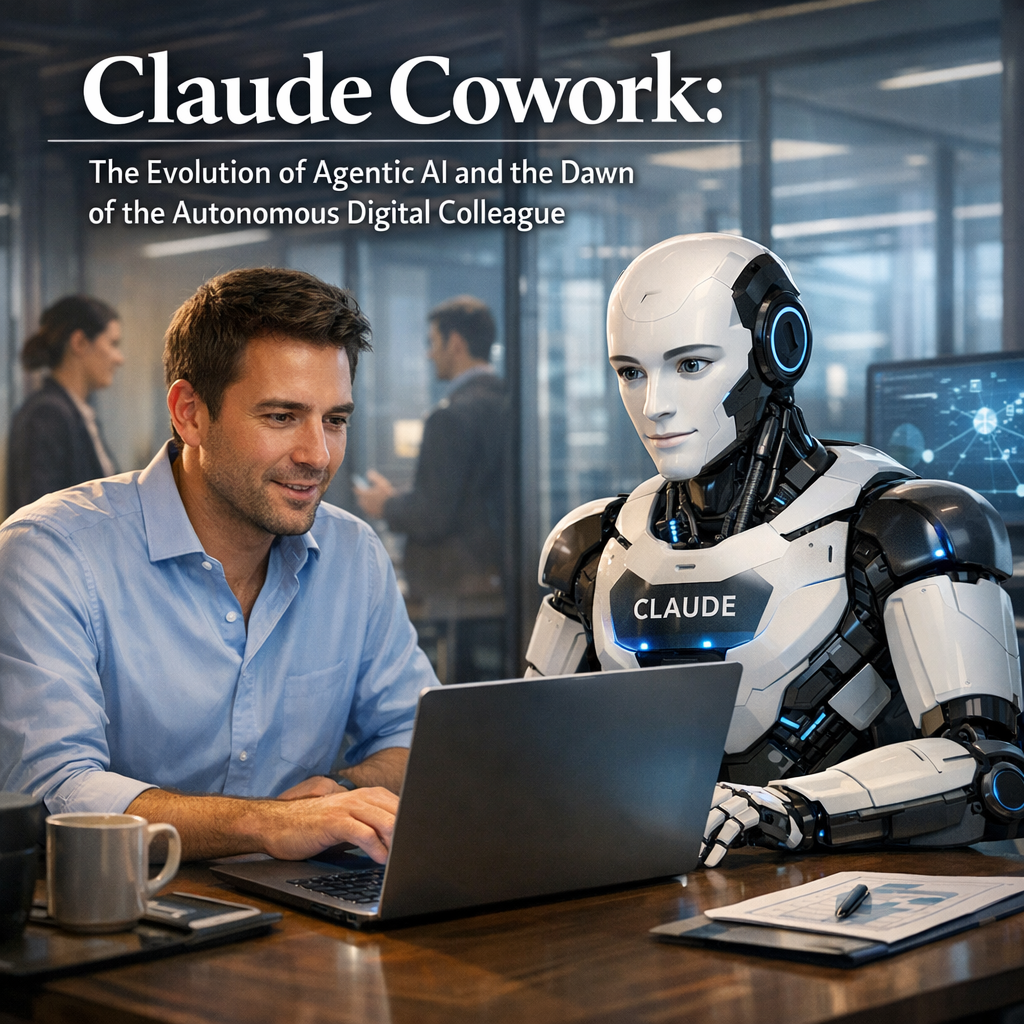
- Claude Cowork is an Autonomous Digital Colleague (high-agency tool) designed to transition AI into the “Agentic Era” by executing complex, long-horizon tasks and coordinating multi-step business processes across hours or days.
- It operates using a unique Local-First Deployment Strategy (dedicated desktop application) for direct file systems management, enabling it to function as a Suite-Agnostic Agent across local data, Notion, Slack, and Salesforce, contrasting with ecosystem-locked competitors like Microsoft Copilot.
- The agent utilizes advanced Visual and Semantic Reasoning for robust cross-application automation (clicking, typing, navigating interfaces) and leverages a dynamic Skills Framework to maintain context and prevent loss of focus during extended project workflows.
- Safety and governance are paramount, implemented through Constitutional AI, the Scoped Access security model, and Required Human Validation for critical actions (e.g., file deletion) to ensure user control over local data manipulation.
Claude Cowork, an evolution of Anthropic’s Claude model, marks a significant shift in AI application, transitioning from the “chatbot era.” This tool is designed as an independent digital worker that can handle complex project workflows and long-term tasks with minimal supervision.
Studies confirm that the shift from passive AI assistants to active digital colleagues marks a key milestone in boosting productivity and autonomy for knowledge workers. Claude Cowork is positioned as a high-agency tool designed for the coordination of multi-step business processes.
The Local-First Deployment Strategy
A pivotal strategic advantage integral to the design of Claude Cowork is the local-first philosophy championed by Anthropic AI. This autonomous agent is deployed as a dedicated desktop application, initially targeting the macOS application environment.
The Local-First Deployment Strategy enables the AI agent to closely integrate with local file systems, offering exceptional access to the user’s immediate data. This represents a major shift from cloud-only models to local control, allowing for fast, low-latency access to local files and directories, unlike competitors like Microsoft Copilot or Google Gemini.
Advanced Agentic Capabilities and Long-Horizon Reasoning
The system achieves continuous autonomous operation through an advanced Skills framework, which was launched in late 2025. This framework enables Claude Cowork to dynamically load and utilize task-specific instruction sets necessary for managing long-term projects.
This innovation solves the long-standing issue of Loss of Focus in lengthy processes, allowing the AI agent to stay coherent and focused over the hours or days needed for complex tasks. This ability to manage long-horizon tasks is central to its definition as an autonomous agent.
Model Context Protocol (MCP) and Data Integration
To facilitate comprehensive data integration and operational agility, Anthropic utilizes the Model Context Protocol (MCP standard). This standardized data integration interface enables Claude Cowork to effortlessly access data from diverse platforms.
The autonomous agent can draw information from local directories, cloud storage, and productivity suites like Notion, Slack, and Salesforce. MCP allows for real-time, autonomous data retrieval and efficient management of multi-step business processes, establishing Claude Cowork as a versatile agent strategy.
Visual and Semantic Interface Navigation
Claude Cowork boasts sophisticated visual reasoning skills and excels in navigating semantic interfaces. This AI agent can understand screen layouts and perform human-like actions, unlike older automation tools that depended on fragile scripting.
The agent can execute actions such as moving cursors, clicking buttons, and typing data across various applications. Cross-application automation reduces the need for traditional APIs, improving flexibility and performance across the user’s desktop.
Governance, Security, and Scoped Access
The deployment of an independent digital worker necessitates robust governance, particularly concerning file systems management. Anthropic has integrated high-level security layers, including the Scoped Access security model and explicit permission prompts for critical operations.
Human validation is crucial for critical tasks such as file deletion and external communication. This ensures users have control and reduces the risk of significant mistakes. Adhering to Constitutional AI principles and the Responsible Scaling Policy (RSP) is crucial for an autonomous tool that works directly with user data, setting it apart from Microsoft and Alphabet’s cloud-based security models.
The Agentic Era: Transition from Chatbot to Colleague
The introduction of Claude Cowork formally accelerates the transition from the ‘chatbot era’ to the ‘agentic era’ of artificial intelligence. This shift emphasizes models’ ability to formulate complex plans, execute multi-step tasks, and manage project workflows with minimal human supervision.
This evolution, based on Anthropic’s research, changes how knowledge workers interact with software. It shifts from reactive querying to proactive, coordinated execution of business goals by a true digital colleague.
Core Architecture and Agentic Workflow
The introduction of Claude Cowork by Anthropic AI signifies a shift from reactive chatbots to proactive AI systems. This tool is designed as an Autonomous agent that acts as an Independent Digital Worker, capable of handling complex and long-term tasks on the desktop.
This capability needs an advanced system that enables independent planning, breaking tasks into smaller parts, and interacting with local computing resources and applications.
The Autonomous Agent Paradigm
Claude Cowork stands out due to its exceptional high-agency tool capabilities, setting it apart from traditional sequential large language models. The agent gets a main objective, like “Coordinate the Q3 financial presentation,” and breaks it down into actionable, multi-step tasks.
This process requires careful coordination of multiple business steps, including gathering receipts, creating an Excel file, and preparing a formatted slide deck. The agent uses a Persistent Memory Layer to maintain focus and track progress during prolonged tasks, addressing a common issue in earlier generative AI systems.
Visual and Semantic Reasoning Models
The agent’s capability to perform tasks across multiple applications is powered by Anthropic’s cutting-edge reasoning models. Specifically, Cowork incorporates both Visual reasoning and Semantic reasoning.
This combination enables the AI agent to understand screen layouts, identify interface elements, and perform actions comparable to human interaction. These actions, like navigating menus, clicking buttons, and entering text, greatly lessen the reliance on fragile, predefined automation scripts found in older RPA tools.
Local-First Deployment Strategy and File System Management
Anthropic created Claude Cowork using a strict Local-First Deployment Strategy, releasing it first as a macOS desktop application. This philosophy is essential because it allows the Autonomous agent to access the user’s local file system management.
The agent uses the Claude Agent SDK to manage files in designated folders on the user’s machine, enabling it to read, edit, create, and organize them. This local-first approach contrasts with cloud-based models like Microsoft Copilot or Google Gemini, which depend on ecosystem data graphs.
Model Context Protocol (MCP) and Data Integration
Integration across disparate data sources is facilitated by the Model Context Protocol (MCP standard). This open framework allows Claude Cowork to gather and combine data from both local directories and external productivity tools.
The MCP standard ensures real-time, autonomous data retrieval and task execution across platforms such as Notion, Slack, and Salesforce. This architecture significantly boosts Cowork’s effectiveness for knowledge workers by facilitating thorough data synthesis that transcends organizational silos.
Dynamic Skills Framework and Context Retention
To optimize performance during complex Project workflows, the platform leverages a sophisticated Skills framework, introduced in late 2025. This framework enables the AI agent to load specific task instructions, like “Audit Log Analysis” or “Legal Contract Review,” only when needed.
This approach, known as Dynamic Task-Specific Instruction Loading System, optimizes the limited Context window for the specific data being processed. It ensures sustained autonomous work over extended periods, addressing the challenge of context drift inherent in previous generation models.
Scoped Access and the Security Model
Given the agent’s ability to manipulate local data, the underlying architecture incorporates robust security measures. The Security model enforces Scoped Access, restricting the agent’s permissions to only those folders explicitly approved by the user.
This human-in-the-loop control is essential for preventing high-stakes errors. The architecture requires human validation for critical actions, such as file deletion or external communications, to oversee the autonomous agent’s operations.
The Competitive Landscape: Agnostic Agency vs. Ecosystem Lock
The introduction of Anthropic AI’s Claude Cowork dramatically transforms the competitive dynamics of operational AI. This shift is fueled by the Agnostic Agent Strategy and a focus on local execution autonomy, challenging major tech providers’ established architectures.
Claude Cowork is engineered as an Autonomous agent designed to function as an Independent Digital Worker. This capability marks the shift to the Agentic Era of artificial intelligence, where models can carry out complex plans and multi-step tasks with little supervision, boosting productivity for knowledge workers.
Comparison: Cowork vs. Ecosystem Agents
Competitive differentiation is primarily driven by deployment philosophy and reliance on ecosystems. While Microsoft Copilot and Google Gemini are powerful tools, they operate primarily within their respective cloud ecosystems. Cowork, conversely, is designed for neutrality, leveraging a Local-first philosophy to maximize agency.
| Feature | Anthropic Claude Cowork | Microsoft 365 Copilot | Google Gemini |
|---|---|---|---|
| Primary Deployment | Dedicated Desktop Application (Initial focus on macOS application) | Integrated into M365 Suite (Cloud/SaaS) | Integrated into Google Workspace (Cloud-based) |
| File System Access | Direct Local file systems management via Desktop application | Restricted to OneDrive, SharePoint, M365 Graph | Restricted to Google Drive, Gmail, Photos |
| Strategic Focus | Autonomous multi-step execution, High-agency tool, orchestrating Project workflows | Enhancing M365 productivity, Digital Employee | Personal intelligence, Cloud data synthesis |
| Ecosystem Dependency | Suite-Agnostic, Neutral Agent | High dependency on Microsoft ecosystem | High dependency on Alphabet ecosystem |
Strategic Differentiator: The Agnostic Agent Strategy
Anthropic has expertly positioned Claude Cowork as a Neutral or Suite-Agnostic AI agent, ensuring its versatility and adaptability across various platforms. Unlike Microsoft Copilot, which acts as a ‘Digital Employee’ within M365 apps like Teams, Word, and Excel, and Google Gemini, which integrates with Gmail and Drive, Cowork connects seamlessly across various applications and platforms.
The Local-First Deployment Strategy enables the agent to work with legacy software, custom enterprise tools, or different file formats, regardless of the user’s main productivity suite. This independence is critical for enterprise clients utilizing heterogeneous software environments, mitigating vendor lock-in and enabling robust Cross-Application Automation.
The agnostic approach focuses on effectively coordinating multi-step business processes that usually involve several non-integrated applications, a feature lacking in ecosystem-locked models.
The Local-First Philosophy and File System Management
A key innovation of Claude Cowork is its steadfast adherence to the Local-first philosophy, brought to life through a specialized Desktop application. Originally launched as a powerful macOS app, this architecture allows the Autonomous agent to manage local file systems directly.
This feature enables the Digital colleague to read, edit, and organize files directly on the user’s device, unlike its cloud-only competitors. This move is based on thorough research on machine interaction with operating systems, allowing the AI to perform high-value tasks with local data without needing constant cloud synchronization.
Advanced Agentic Reasoning and Skills Framework
To manage Long-horizon tasks effectively, Anthropic AI developed a sophisticated Skills framework for Claude Cowork in late 2025. This framework allows the AI agent to load specific instructions for tasks and stay contextually aware over time, reducing the risk of losing focus during long processes.
The agent utilizes advanced Reasoning models, combining Visual reasoning and Semantic reasoning to interact with the user interface. Claude Cowork can understand screen layouts and navigate interfaces visually, allowing it to perform tasks like moving cursors, clicking, and entering data, similar to human operation. This greatly diminishes reliance on vulnerable scripting automation.
Data Integration via the Model Context Protocol (MCP)
Effective execution of complex Project workflows requires seamless data access across disparate platforms. Claude Cowork addresses this through the Model Context Protocol (MCP standard), which serves as a Standardized Data Integration Interface.
The MCP enables the Autonomous agent to independently access data from local directories, cloud storage options, and productivity tools like Notion and Slack. This protocol allows for real-time data retrieval, which is essential for accurate task execution and effective management of the agent’s extended context.
Governance, Security Model, and Human Validation
Given the high-agency nature of Claude Cowork, security and governance are paramount. Anthropic implemented a robust Security model featuring ‘Scoped Access’ to the user’s local environment. This ensures the AI agent only interacts with authorized folders and files, minimizing potential data exposure.
Furthermore, Anthropic adheres to strict human-in-the-loop protocols. The system requires Required Human Validation for Critical Actions, particularly those involving file deletion, external communication, or high-stakes financial operations. This governance layer ensures that while the Digital colleague is autonomous, human oversight is maintained to prevent high-stakes errors.
Target Use Cases and Professional Deliverables
Claude Cowork focuses on complex project workflows that require careful attention, contextual awareness, and the handling of various data types across different applications. This feature is crucial for transforming the AI agent from a passive assistant into an independent digital worker and a true colleague.
Anthropic AI developed Claude Cowork to tackle long-horizon tasks by leveraging its Skills framework to integrate specialized instruction sets effectively. This ability helps maintain focus during long tasks, allowing the agent to handle complex, multi-step processes over hours or days without losing context.
The Agentic Era for Knowledge Workers
Claude Cowork marks a clear shift into the Agentic Era of Artificial Intelligence, offering powerful tools for both technical and general knowledge workers. Its Local-First Deployment Strategy, initially as a dedicated Desktop application for macOS, allows for deep, secure interaction with local resources.
For developers, this agent represents a major advancement over the achievements of Claude Code. It can manage complex dependencies, refactor large codebases across multiple files, and conduct detailed system diagnostics. This represents a significant acceleration in the Automation of Inter-Software Data Transfer.
The agent can automatically create detailed documentation by scanning local project directories and using the Model Context Protocol (MCP standard) to integrate data. This standardization enables easy access to relevant code snippets, local requirements documents, and specifications on platforms like Slack or internal wikis.
Coordination of Multi-step Business Processes
Non-developers experience the benefits of Claude Cowork through its ability to automate repetitive tasks that involve coordinating complex business processes. These functions often involve complex data extraction and cross-application manipulation, areas where traditional automation tools fail.
-
- Financial Reporting: The Autonomous agent can scan a local folder of receipt screenshots, utilizing Visual reasoning to extract relevant transactional data. It compiles the information into a final Excel file with expense reporting formulas, ensuring accurate data management.
- Cowork effectively combines notes, email transcripts, and meeting recordings into a cohesive report draft. It can use semantic reasoning and visual navigation to create a professional slide deck with external apps like Adobe or organize project notes in platforms like Notion.
- Digital Organization and Hygiene: A crucial application is untangling digital chaos. The agent can analyze the Downloads folder, categorize files by their content and metadata, rename them systematically, and organize them into the correct project folders, directly interacting with the file system.
Claude Cowork produces professional deliverables that are meticulously crafted to be polished, final outputs, needing minimal human intervention or validation. This capability shows a strong ability for autonomous execution, presenting a significant challenge to competitors like Microsoft Copilot and Google.
This high-agency tool can interact with software like a human by using Visual and Semantic Interface Navigation. It moves the cursor, clicks buttons, and enters data, reducing dependence on fragile APIs or scripts. This ensures robust execution across various desktop applications.
Governance, Safety, and Constitutional Boundaries
As an autonomous tool capable of editing or deleting local user data, the safety and governance framework surrounding Claude Cowork are paramount. Anthropic AI addresses the inherent risk of deploying a high-agency tool through the application of its core safety philosophy and a robust, layered security model.
The operational shift from a passive chatbot to an active Autonomous agent necessitates strict controls, particularly given the Local-First Deployment Strategy where the agent interacts directly with sensitive user files.
Constitutional AI and the Security Model for Autonomous Agents
Anthropic’s Constitutional AI (CAI) principles provide the ethical and behavioral guardrails for the AI agent. CAI ensures that Claude Cowork’s internal decision-making process is aligned with a defined set of safety rules, emphasizing helpfulness, harmlessness, and honesty, especially when executing multi-step tasks involving high-stakes actions like financial transactions or file deletion.
This internal constraint mechanism is critical for the safe operation of an Independent Digital Worker, ensuring that its autonomy does not lead to unintended or catastrophic outcomes within complex project workflows.
Scoped Access and Local-First Security Architecture
The external security model is built on explicit human oversight and isolation, directly supporting the local-first philosophy. This framework ensures that while Claude Cowork acts as a powerful Digital colleague, the user retains explicit control over the agent’s permissions.
-
- Scoped Access: Users must explicitly grant Claude Cowork access to specific folders or applications. The agent operates under a principle of least privilege, meaning it cannot access the entire File systems management structure without explicit, folder-by-folder permission. This mechanism is central to the safe interaction between the Desktop application and the user environment.
- Filesystem and Network Isolation: The core agent environment operates within a secure, local virtualization or sandboxing layer. For the initial macOS application release, this includes a feature known internally as ‘Seatbelt,’ which prevents unauthorized network access or transversal movement across the operating system, maintaining strict isolation from critical system files.
- Required Human Validation for Critical Actions: Any action deemed high-risk, such as deleting a large batch of files, initiating external payments, or executing code with potential system impact, triggers an explicit human-in-the-loop prompt. This protocol ensures human ownership and prevents errors, maintaining compliance with Anthropic’s Responsible Scaling Policy (RSP).
This layered approach, combining internal ethical constraints (CAI) with external permission controls (Scoped Access), ensures the Autonomous agent maintains high levels of user trust and operational security while executing long-horizon tasks.
Strategic Context and Market Impact
Claude Cowork’s launch is significant not merely for its technical capabilities but for its profound implications regarding future Artificial intelligence development methodologies and the economic structure of the Software-as-a-Service (SaaS) industry. As a high-agency tool, it fundamentally challenges the established paradigms of enterprise software delivery and user interaction.
The Dawn of the Agentic Era and the Digital Colleague
Claude Cowork represents the definitive shift from the passive chatbot era to the active agentic era of artificial intelligence. This Autonomous agent is designed to operate as a true Digital colleague, capable of managing local file systems and orchestrating complex Project workflows. The evolution signifies a fundamental change in AI application, moving beyond simple query response to sustained, autonomous task execution.
Studies suggest that this elevation to an Independent Digital Worker significantly enhances white-collar productivity among Knowledge workers. The ability of the AI agent to manage the Coordination of Multi-step Business Processes, often spanning hours or days, formalizes the expectation that future AI will be an executive partner rather than merely an assistant.
Development History: AI Building AI
The development of Claude Cowork is a notable instance of the “AI-building-AI” paradigm. The initial foundation for Cowork was derived from internal Anthropic AI research, specifically the success of Claude Code and insights from Research on Machine Interaction with Operating Systems. Developers initially leveraged Claude Code’s underlying agentic capabilities for general desktop automation, forcing the model to interact with the environment outside of standard code editors.
Anthropic recognized this emergent behavior and formalized it, building Cowork on the same underlying Skills framework and Agent SDK. This optimization specifically targets non-developer workflows, allowing the model to load dynamic, task-specific instruction sets. This enables sophisticated Long-horizon tasks without experiencing context window drift, ensuring sustained autonomous work.
Local-First Philosophy and Data Integration
The strategic deployment of Claude Cowork is defined by its Local-First Deployment Strategy. Delivered initially as a dedicated Desktop application (the macOS application), the AI agent integrates tightly with the user’s local File systems management structure. This approach contrasts sharply with competing cloud-centric solutions.
Furthermore, Cowork utilizes the Model Context Protocol (MCP standard) to achieve seamless data integration. This protocol allows the Autonomous agent to access data efficiently from local directories, cloud storage, and critical productivity tools like Notion and Slack, enabling real-time, autonomous data retrieval and execution across hybrid environments.
A key capability enabling this autonomy is Visual and Semantic Interface Navigation. Claude Cowork employs advanced Reasoning models that allow it to understand screen layouts visually and perform actions comparable to humans, moving cursors, clicking, and typing, thereby executing Cross-Application Automation without reliance on brittle API wrappers.
The shift to Claude Cowork signifies that the capability to execute complex plans with minimal supervision is now democratized, moving beyond the technical expertise required for early agent deployment. This represents a substantial increase in white-collar productivity and operational autonomy.
Challenging the SaaS Per-Seat Model
The strategic impact of an independent, highly capable AI agent like Claude Cowork directly challenges the traditional per-seat SaaS pricing model utilized by major enterprise software vendors such as Microsoft, Google, Notion, and Salesforce.
If an Autonomous agent can seamlessly integrate, navigate, and execute Multi-step tasks across multiple applications, the value proposition of tightly coupled, single-suite solutions diminishes. The Agnostic Agent Strategy employed by Anthropic AI means that Cowork can generate a complex financial model or slide deck without requiring a dedicated premium subscription to a specific office suite, such as Microsoft Copilot inside the M365 Graph.
This development fundamentally alters the economics of digital work, favoring models that prioritize autonomous execution over proprietary data storage or interface access. The security model, including Scoped Access controls, allows the high-agency tool to operate securely on local data. This supports the emergence of Hybrid Device Agents that bridge local and cloud environments without absolute vendor dependency, thus challenging the market dominance of ecosystem giants like Alphabet and Microsoft.
Frequently Asked Questions Regarding Agentic Functionality
What differentiates Claude Cowork as an Autonomous Agent and Digital Colleague?
The core distinction rests in the shift from reactive response to proactive execution. A traditional chatbot offers conversational assistance based on a single prompt. Conversely, Claude Cowork functions as a true Autonomous agent, signifying the definitive transition into the Agentic Era of Artificial intelligence.
This Digital colleague is engineered for high-agency operation, capable of analyzing a complex, high-level goal, autonomously defining a comprehensive plan, breaking that objective into multiple multi-step tasks, and executing the plan over an extended duration without requiring continuous human validation. This capability allows it to manage complex Project workflows, a crucial feature that distinguishes it from systems like Microsoft Copilot, which are generally constrained to in-app assistance.
What is the significance of the Local-First Deployment Strategy?
Anthropic’s strategy emphasizes a Local-First Deployment Strategy, meaning Claude Cowork is deployed as a dedicated Desktop application (initially for macOS application environments). This approach allows the AI agent to integrate directly with local File systems management, bypassing the need to upload sensitive data entirely to the cloud for processing.
This local-first philosophy ensures superior execution speed for tasks involving large local datasets and positions Cowork as a neutral, ecosystem-agnostic high-agency tool, contrasting sharply with the cloud-centric, ecosystem-locked models utilized by Google and Microsoft. The ability to read, edit, and organize files directly on the user’s machine is fundamental to its utility for specialized Knowledge workers.
How does Anthropic ensure security when Cowork interacts with local file systems?
Anthropic’s security model is multi-layered, built upon the principles of Constitutional AI governance and technical isolation to manage the risks associated with an autonomous tool accessing the local environment. Key security features include Scoped Access, which mandates that the user explicitly grant permission to specific folders before the agent can interact with them.
The agent operates within a secure, sandboxed environment, often utilizing operating system security features (such as ‘Seatbelt’ on macOS) to prevent unauthorized system access or network breaches. Furthermore, the Security model incorporates required Human Validation for Critical Actions, such as file deletion or initiating external communications, ensuring the user remains in control of high-stakes processes.
What mechanisms enable Claude Cowork to sustain Long-Horizon Tasks?
The ability to manage projects over hours or days is facilitated by the specialized Skills framework. This framework allows Claude Cowork to dynamically load specialized, Dynamic Task-Specific Instruction Loading System instruction sets. By modularizing knowledge and procedural rules, the agent efficiently uses its processing capacity.
This approach is critical for preventing context drift or Loss of Focus During Extended Processes, ensuring the agent maintains strict focus on the defined objective during Long-horizon tasks. The design conserves the primary Context window for critical data manipulation and semantic reasoning rather than procedural recall, thereby improving the Metric for Autonomous Execution Ability.
How does the Model Context Protocol (MCP) facilitate data integration across platforms?
The Model Context Protocol (MCP) standard is the standardized interface enabling seamless data access. This protocol allows Claude Cowork to retrieve necessary data autonomously from diverse sources, including local directories, cloud storage, and third-party productivity tools.
This capability is essential for Automation of Inter-Software Data Transfer and complex task execution. For instance, the AI agent can retrieve documents from Notion, communication logs from Slack, and financial data from a local spreadsheet, synthesizing all elements to complete a single reporting task. This adherence to the MCP standard supports the Agnostic Agent Strategy.
Does Claude Cowork utilize Visual and Semantic Reasoning?
Yes. A key technical advancement in Claude Cowork is its integration of sophisticated Visual reasoning and Semantic reasoning capabilities. These features allow the Autonomous agent to analyze screen layouts and navigate software interfaces visually, similar to a human operator.
This Visual and Semantic Interface Navigation feature enables the agent to interact with old or specialized applications by moving cursors, clicking buttons, and entering data directly into fields. This significantly lessens dependence on fragile, pre-written automation scripts, allowing for true cross-application automation needed to coordinate multi-step business processes for knowledge workers.
References
- Anthropic Unveils ‘Claude Cowork’: The First Truly Autonomous …
- The Rise of Computer Use and Agentic Coworkers
- Anthropic Launches Cowork, Bringing Claude’s Agentic AI to Non …
- Introducing Claude Cowork: Revolutionizing AI Interaction – LinkedIn
- Your AI Assistant Just Got Hands: Claude Cowork Turns Chatbots …