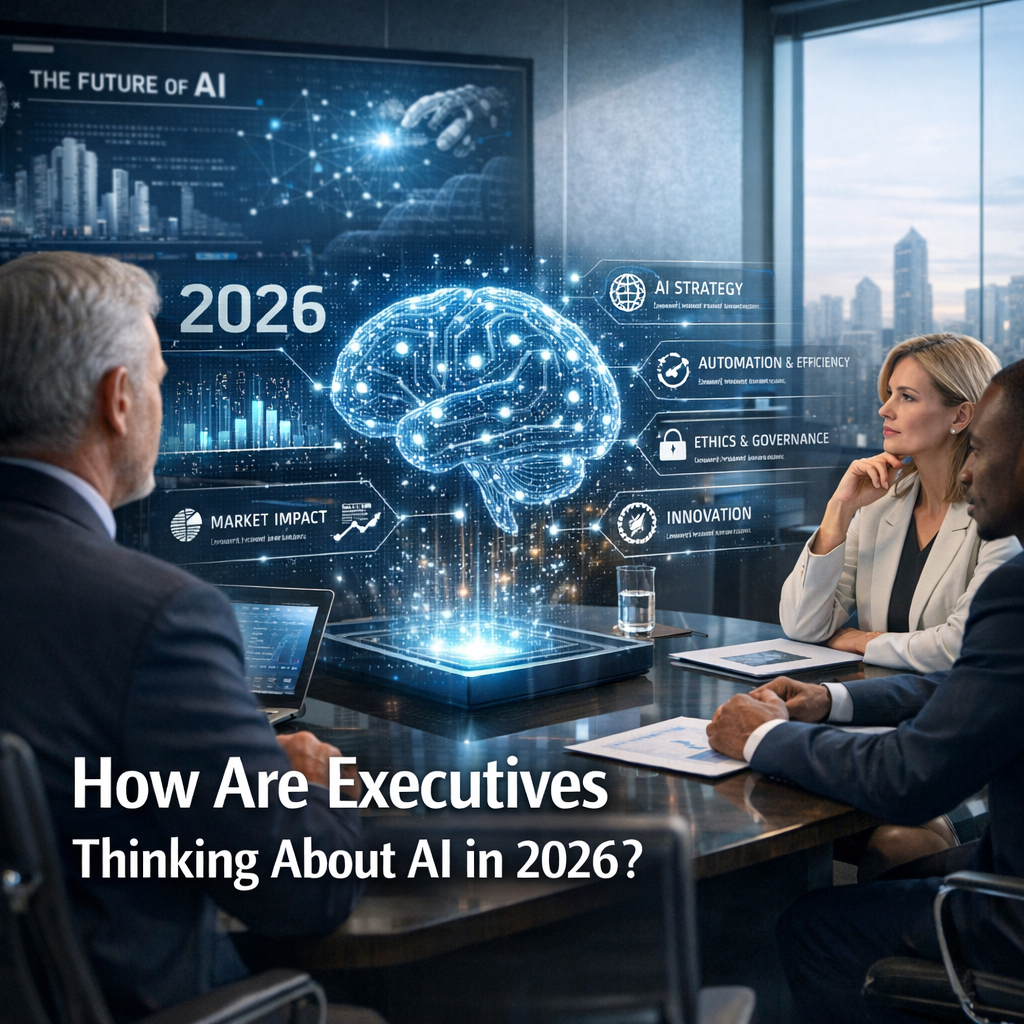
Six Mandates: Executive AI Governance in 2026
- AI is a CEO Mandate: The discussion has shifted from adoption to systemic governance. Investment is doubling year-over-year, and 72% of CEOs identify themselves as the primary decision-makers on AI Strategy.
- Strategic Clarity Trumps Technology: AI only delivers measurable business value when aligned with explicit Strategic Clarity and rigorous Operating Discipline; it accelerates activity but cannot create direction.
- Transformation is Non-Negotiable: Scaling AI requires aggressive Infrastructure Maturation (allocating 30-40% of transformation budgets to replacing legacy systems) and significantly increasing Executive Technology Know-how and workforce upskilling.
- Mandates Focus on Risk: Executives must proactively implement Six Critical Mandates, emphasizing Algorithmic Accountability and establishing strict governance frameworks (including human override protocols) for autonomous Agentic AI systems.
Table of Contents
- The CEO Mandate for AI Strategy
- From Acceleration to Strategic Clarity
- The Operational Shift: From Adoption to Governance
- Six Critical Mandates for Enterprise AI Investment
- The Executive Mandate: Defining the Trailblazer’s Strategic Advantage
- The Competitive Edge
- Executive Q&A: Addressing the 2026 AI Mandate
By February 2026, the discussion regarding Artificial Intelligence (AI) has fundamentally shifted. It is no longer about tentative AI Adoption or pilot projects; it is about systemic governance and strategic differentiation.
The recent AI & Data Leadership Executive Benchmark Survey shows that companies are doubling their AI investments each year, fueled by an 82% rise in CEO optimism about achieving business value. This unprecedented capital allocation signals the definitive end of the experimental phase for Enterprise AI.
The CEO Mandate for AI Strategy
This operational change has firmly positioned AI Strategy at the forefront of boardroom discussions. Executive Thinking has matured past simple AI Optimization toward embedding cognitive systems into core business processes.
Surveys in the Enterprise Technology Intelligence Briefing show that 72% of Technology Executives and Business Leaders see the CEO as the main decision-maker for AI deployment. Half of CEOs believe their job stability depends on successful AI integration, making AI a crucial part of the CEO role.
This mandate requires a comprehensive Digital Transformation. Organizational structures are changing to accommodate Agentic AI, with about one-third of transformation budgets focused on replacing old systems with AI-powered platforms.
From Acceleration to Strategic Clarity
However, increased Enterprise Technology spending does not automatically yield desired outcomes. Research from Harvard Business Review and BCG reveals a key issue: Generative AI speeds up tasks but doesn’t provide direction.
AI enhances decision-making speed and quality only when it is aligned with clear strategic objectives and integrated into a disciplined operational framework. Without this foundational structure, investments in AI merely amplify existing organizational complexity.
AI acts as a leadership amplifier, enhancing experienced leaders’ ability to interpret and test assumptions. Less experienced leaders, lacking Executive Technology Know-how, often struggle with the inherent limitations of advanced computational systems.
The real challenge for Executive Thinking in 2026 is managing the resultant systemic risk. The ‘trailblazers’ (15% of CEOs rapidly adopting AI) succeed by prioritizing Core Governance Issues and investing three times more in workforce training.
The six mandates go beyond AI Optimization; they outline essential proactive steps for effectively managing the interaction between technology and long-term organizational resilience.
The Operational Shift: From Adoption to Governance
The conversation surrounding Artificial Intelligence has shifted dramatically as we enter February 2026. The excitement around consumer tools like ChatGPT has shifted to careful evaluation of their long-term business value and risk management.
For Business Leaders and executive teams, the primary focus is no longer simple AI Adoption or pilot projects. It is about governance, control, and achieving true strategic differentiation through embedded Enterprise AI.
By 2026, cognitive systems will evolve beyond simple AI optimization and become integral to the organization’s core operations. This requires a new level of Executive Thinking and formalized oversight.
The CEO Mandate: Investment and Accountability
The recent AI & Data Leadership Executive Benchmark Survey shows that nearly all data and AI leaders now consider AI a top priority. Companies are doubling their AI Investment year-over-year, driven by an 82% increase in CEO optimism regarding future growth.
This commitment starts at the top. Data shows that 72% of CEOs identify themselves as the primary decision-makers on AI Strategy. Nine out of ten CEOs agree that integrating AI into their industries is crucial for job stability.
Failure to effectively govern these systems poses a serious risk, affecting shareholder value and regulatory compliance.
From Acceleration to Strategic Clarity
While AI accelerates activity, it does not create direction. Research from sources like Harvard Business Review highlights that AI enhances decision speed and quality when it is aligned with clear strategic goals.
The true value of Generative AI and Agentic AI is achieved when they are integrated into existing Operating Disciplinary processes, aiding structured growth rather than operating as separate projects.
AI acts as a Leadership Amplifier, not a replacement. It helps experienced leaders interpret complex data and test assumptions, but less experienced leaders often struggle with its technical limitations. This highlights the necessity of high-caliber Executive Technology Know-how in deployment.
The Cost of Digital Readiness
Successful integration of AI necessitates a fundamental transformation within the organization. Nearly all CEOs are preparing to lead transformations that include redrawing organizational structures and addressing severe Technical Debt Sprawl.
Significant investment is required to replace legacy systems with modern, AI-powered platforms. Approximately one-third of organizations allocate over 40% of their total Digital Transformation budgets specifically to AI Transformation initiatives.
The competitive edge belongs to the ‘trailblazers’ who embrace Digital Readiness with high confidence. This 15% group invests three times more in workforce upskilling and spends twice as long on internal AI education, leading to greater capabilities and better business results.
The six mandates below focus on essential governance issues to help your organization shift from reactive compliance to proactive strategic leadership by 2026.
Six Critical Mandates for Enterprise AI Investment
To navigate the complexities of Enterprise AI, Business Leaders must direct capital expenditure and attention toward six non-negotiable areas. These mandates bridge the gap between technical reality and high-level corporate strategy.
1. Algorithmic Accountability and Risk Quantification
The Strategic Imperative
Algorithmic accountability is essential for maintaining trust, shareholder value, and ensuring regulatory compliance. Failures here translate directly into massive financial penalties and irreversible reputational damage.
The Board must view algorithmic risk quantification as equivalent to foundational financial risk modeling. This is a core element of robust Executive Thinking.
The Technical Bridge
The challenge lies in integrating complex MLOps pipelines with existing enterprise risk management frameworks (ERM). This demands transparent model cards, rigorous drift detection, and auditable decision paths, especially for high-stakes Generative Artificial Intelligence deployments.
You need to create a way to track how each output relates to its input data and model settings, ensuring accountability for every AI decision.
Executive Action
The C-suite must fund a dedicated, cross-functional Algorithmic Audit function, reporting directly to the Chief Risk Officer. Implement mandatory annual stress testing for all operational AI models to ensure compliance with established regulatory and ethical standards. This ensures proactive risk management.
2. Infrastructure Maturation and Technical Debt Reduction
The Strategic Imperative
To effectively scale AI, a strong and adaptable foundation is essential. Many organizations struggle with long-standing technical debt, hindering their digital readiness and returns on AI investment.
Your infrastructure is the foundation that limits your AI transformation potential. Failure in this area hinders the achievement of scalable business value.
The Technical Bridge
The Enterprise Technology Intelligence Briefing emphasizes that effective scaling hinges on a strict approach to Digital Integration. This involves moving beyond siloed legacy systems and adopting a modern Technology Stack.
Many tech executives are focusing on a private platform approach with secure hybrid cloud architectures and edge computing to manage large data flows and lower operational costs.
Executive Action
Organizational transformation requires investment in the underlying platform. Allocate 30 to 40 percent of the Digital Transformation budget to replacing legacy systems and enhancing Infrastructure Maturation. Mandate a three-year Long Term Plan focused solely on eliminating technical debt that impedes data flow and model deployment.
3. Strategic Clarity and Outcome Alignment
The Strategic Imperative
AI improves decision speed and quality, but only when aligned with a clear strategy. Research from BCG and Harvard Business Review consistently shows that AI accelerates activity, it does not create direction.
Without clear strategic direction, AI projects often turn into costly, isolated experiments that fail to generate lasting business value. You must define the outcome before applying the computational tool.
The Technical Bridge
This is fundamentally a managerial, not a technical, problem. To truly harness the power of Enterprise AI, it must be seamlessly integrated into current Operating Discipline and structured growth frameworks. It requires identifying high-value, repeatable tasks before applying computational power.
You must ensure that your AI Strategy is derived from, rather than driving, the corporate strategy.
Executive Action
The CEO must personally lead the definition of the three core strategic questions Artificial Intelligence is intended to answer. All AI projects must align with corporate metrics before receiving initial funding, not just provide proof of concept.
4. Cybernetic Resilience and Agentic Governance
The Strategic Imperative
The rise of autonomous, self-directing Agentic Artificial Intelligence poses novel and complex risks. These agents operate outside human intervention loops, creating massive challenges for security, privacy, and systemic control.
Addressing these Core Governance Issues is paramount for business continuity and mitigating unanticipated organizational risk.
The Technical Bridge
The technical challenge involves creating robust, auditable guardrails and monitoring systems for autonomous agents. This expands on traditional cybersecurity by ensuring data origin, preventing attacks on decision-making processes, and managing the system’s unpredictability.
This requires a sophisticated approach to data models and system resilience that accounts for emergent behaviors.
Executive Action
Allocate resources for dedicated research on governance frameworks for Agentic AI. Establish clear kill switches and human override protocols for all autonomous systems deployed in production environments. This ensures control remains with the organization, not solely dependent on Cloud Providers.
5. Capital Prioritization and Investment Scaling
The Strategic Imperative
Investment in Enterprise Technology is accelerating rapidly. Survey data reveals that companies are increasing their AI investments at an astonishing rate, doubling their spending year after year. According to the AI & Data Leadership Executive Benchmark Survey, 82 percent of CEOs report feeling more optimistic about AI compared to the previous year, recognizing it as a critical competitive lever.
Failure to scale investment now means ceding market share to competitors and hindering necessary Digital Transformation.
The Technical Bridge
To achieve scaling, it is essential to transition from limited departmental experiments to comprehensive, standardized platforms that can be implemented across the entire enterprise. This involves centralizing data ingestion, creating reusable model components, and driving down Operational Costs through efficient AI Optimization.
The focus must shift from bespoke solutions to industrialized AI factories to maximize Business Value.
Executive Action
As the primary decision makers on AI, 72 percent of CEOs must ensure budget allocation reflects this priority. Mandate that every major business unit allocate a minimum percentage of its annual budget to AI-related initiatives, tracked against predefined ROI metrics.
6. Executive Technology Know-how and Leadership Amplification
The Strategic Imperative
Half of all CEOs believe their job stability hinges on successful AI integration. AI is fundamentally a CEO mandate, requiring leadership that understands both the potential and the limitations of the technology.
This calls for proactive leadership training rather than mere delegation. This is the foundation of effective Data Leadership.
The Technical Bridge
AI enhances experienced business leaders’ ability to analyze complex data and rapidly test assumptions. However, less experienced leaders struggle with its limitations, highlighting the importance of deep Executive Technology Know-how.
The greatest value of Artificial Intelligence is realized in supporting human judgment, not substituting it.
Executive Action
Emulate the ‘trailblazers’ who are scaling AI rapidly. These leaders dedicate three times the workforce upskilling budget and spend twice as much time on AI education. Mandate personal, ongoing education for all C-suite members on foundational AI concepts and their implications for Strategic Planning.
The Executive Mandate: Defining the Trailblazer’s Strategic Advantage
Successful organizations that achieve strategic business value from AI adoption differ from those stuck in proof-of-concept fatigue primarily due to better governance and capital direction. By February 2026, the leading organizations treat Artificial Intelligence not as a peripheral IT project, but as the core driver of Digital Transformation and systemic competitive differentiation.
The CEO as Chief AI Officer: Investment and Governance
Current Executive Survey data, corroborated by the latest Enterprise Technology Intelligence Briefing, reveals a profound shift in Executive Thinking. Business Leaders are not merely increasing budgets; they are doubling or even tripling their year-over-year AI Investment. This strong position reflects high confidence, with 82% of CEOs feeling much more optimistic about the immediate impact of Generative Artificial Intelligence than last year.
This magnitude of investment requires a corresponding shift in leadership accountability. AI strategy has ceased to be a task relegated to lower levels of the hierarchy. A striking 72% of CEOs identify themselves as the primary decision-maker on Enterprise AI initiatives. This highlights that AI success is a priority for CEOs, closely tied to long-term shareholder value and job security, requiring improved strategic planning and accountability.
Operationalizing Strategy: From Proof of Concept to Business Value
The true measure of a trailblazer lies in how they embed AI into their core Operating Discipline. Research by BCG and Harvard Business Impact shows that AI enhances decision speed and quality only when it is closely aligned with clear strategic goals. Without proper alignment, AI simply amplifies activity without establishing a constructive direction, frequently leading to costly Technical Debt Sprawl.
To address this challenge, forward-thinking leaders are dedicating themselves to a thorough AI transformation. They are prepared to lead organizational change that includes “redrawing” organizational structures and replacing legacy systems with integrated, AI-powered platforms. About one-third of these leaders dedicate over 40% of their Digital Transformation budget to core AI initiatives, rather than just on operational costs or minor AI improvements.
This dedication encompasses our human resources as well. These organizations dedicate three times the budget to workforce Digital Readiness and upskilling compared to laggards. This focus highlights that Artificial Intelligence enhances experienced Business Leaders’ judgment rather than replacing it. This investment in Executive Technology Know-how is non-negotiable for successful deployment.
The following table illustrates the strategic disparity between advanced and lagging Enterprise AI adopters, based on recent Executive Survey data.
| Area of Focus | Trailblazer Organizations (Top 15 percent) | Laggard Organizations (Bottom 50 percent) |
|---|---|---|
| Investment Growth (YOY) | Doubling or Tripling AI Investment | Static or modest 10 to 15 percent increase |
| Leadership Mandate | CEO-led, 72 percent identify as primary decision-maker. | Delegated to CIO or middle management |
| Budget Allocation | Over 40 percent of Digital Transformation budget goes to AI. | Less than 15 percent, focused on Operational Costs |
| Upskilling Commitment | Three times the budget dedicated to workforce Digital Readiness | Minimal investment, relying on external hires |
| Risk Management Focus | Proactive governance of Agentic AI and Data Models, addressing Core Governance Issues | Reactive compliance checks |
The trailblazer advantage is characterized by proactive governance, particularly when it comes to emerging systems such as Agentic Artificial Intelligence. While laggards wait for regulations, trailblazers are building the necessary Technology Stack and Infrastructure for secure and scalable Private Platform deployment. This proactive dedication to Data Leadership guarantees ongoing competitive superiority.
The Competitive Edge
Following these six mandates helps the organization shift from reactive compliance to proactive strategic leadership in the age of Generative Artificial Intelligence and Agentic AI. By aligning Data Leadership with Executive Technology Knowledge, Business Leaders ensure that Enterprise AI enhances human potential and drives Digital Transformation.
The future of the enterprise is defined by how effectively you integrate autonomous systems into your fundamental Operating Discipline. This integration represents the key metric for success in 2026.
The CEO Mandate: AI Investment and Strategic Clarity
The data is unequivocal: AI Investment is no longer discretionary, but a strategic necessity. This signifies a profound advancement in Executive Thinking. According to the latest AI & Data Leadership Executive Benchmark Survey, companies are doubling their AI Investment year-over-year. Nearly every data and AI leader is planning to increase spending, cementing AI as a high priority.
Eighty-two percent of CEOs are more optimistic about adopting Artificial Intelligence than last year, acknowledging the urgent need for improved infrastructure to support these systems. This shift places the burden of success squarely on Business Leaders.
A staggering 72% of CEOs identify themselves as the primary decision-makers on AI Strategy. They are engaging directly with the challenges of Enterprise Technology and Digital Readiness. Nine out of ten CEOs are engaging in confident discussions about the impact of AI on their industries, recognizing that effective AI transformation is crucial for success. Half of CEOs now think their job stability depends on successful AI integration, highlighting that AI is primarily a CEO responsibility, not just a concern for tech executives.
Institutionalizing AI: Transformation and Strategic Outcomes
The ultimate goal of increased AI Adoption is the realization of measurable Business Value. A study from the Harvard Business Review shows that AI enhances decision-making speed and quality when there is clear Strategic Clarity. Without this alignment, AI accelerates activity but fails to create direction.
This highlights the importance of integrating AI into current Operating Disciplines to support structured growth, instead of pursuing separate proof-of-concept projects that lead to Technical Debt Sprawl.
Crucially, Artificial Intelligence serves as a leadership amplifier, not a replacement. AI enhances experienced leaders’ ability to interpret vast datasets and test assumptions, rather than substituting human judgment. This requires deep Executive Technology Know-how across the organization to ensure the systems are governed correctly.
Nearly all CEOs are preparing to lead organizational transformations by restructuring their companies around Enterprise AI for better digital integration. This requires significant investment to replace outdated systems with integrated, AI-driven platforms, which are essential for modern Digital Transformation. One-third of top organizations allocate more than 40% of their transformation budgets to AI initiatives, underscoring the commitment needed for effective AI transformation.
The Competitive Edge of Trailblazing Leaders
The commitment demonstrated by Technology Executives and Business Leaders separates market leaders (the Trailblazing Leaders) from their followers. Currently, 70% of CEOs are scaling their AI initiatives rapidly, with 15% embracing AI Adoption with high confidence. These trailblazers triple their workforce upskilling budget and spend twice as long on AI education and strategic planning.
This initiates a competitive cycle in the deployment of advanced Generative Artificial Intelligence and Agentic Artificial Intelligence. Starting in 2026, the priority should be to integrate AI into the organization’s structure and establish strong governance to mitigate potential risks. This move secures the long-term competitive advantage.
As Samuel Finch noted in the Harvard Business Impact analysis, “AI success is a managerial challenge, not a technological one. The system is only as smart as the strategy it supports.”
Adherence to these six mandates shifts the organization from reactive compliance to proactive strategic dominance in the era of Generative Artificial Intelligence and Agentic AI. By combining Data Leadership with Executive Technology Knowledge, Business Leaders ensure that Enterprise AI enhances human potential and drives strategic success.
Executive Q&A: Addressing the 2026 AI Mandate
What is the biggest misconception among Business Leaders regarding AI in 2026?
A common misconception is that Artificial Intelligence can make up for a lack of foundational Strategic Clarity, as noted by Chief Outsiders and the Harvard Business Review.
AI excels at acceleration and AI Optimization, but it fundamentally cannot define the direction of the business itself. Its true value is most effectively harnessed when it enhances established, structured growth processes and reinforces strong Operating Discipline. If the strategy is flawed, AI only accelerates the error.
Is the high rate of AI Investment sustainable in the long term?
The latest AI & Data Leadership Executive Benchmark Survey shows that Enterprise AI investment intentions are strong and growing. Companies are doubling their annual budgets for advanced computational systems, with most data and AI leaders planning significant increases.
In fact, 82% of CEOs report being more optimistic about AI compared to the previous year. The main issue in sustainability is not a lack of funding, but the inability to transition quickly from pilot programs to measurable, scaled business value. Innovative organizations, which make up 15% of the market, are allocating three times more budget for workforce upskilling. They justify their high spending through advanced AI adoption and clear returns on investment.
To what extent is AI Strategy now a CEO Mandate?
It is now indisputably a CEO mandate. Recent surveys show that 72% of CEOs identify themselves as the primary decision-makers regarding organizational AI Strategy and Strategic Planning. Nine out of ten CEOs are confidently discussing AI’s industry impacts, recognizing that successful integration drives competitive advantage.
Furthermore, approximately half of all CEOs believe their job stability hinges directly on successfully guiding the organization through AI Transformation. AI is now central to Digital Transformation and requires leadership from the top.
What is the greatest organizational barrier to scaling Enterprise AI?
The primary barrier is not technology availability but organizational structure and the burden of Technical Debt Sprawl. Most CEOs are planning to restructure their organizations to align with AI-driven processes, as reported by BCG and the Enterprise Technology Intelligence Briefing.
Significant capital expenditure is being directed toward replacing legacy systems with integrated platforms. One-third of major enterprises dedicate over 40% of their transformation budgets to AI initiatives and upgrading infrastructure, understanding that achieving Digital Readiness demands moving away from outdated systems.
How does Agentic AI differ from Generative AI for Executive Thinking?
Generative Artificial Intelligence, such as ChatGPT, mainly handles content creation and summarization, whereas Agentic Artificial Intelligence poses new risks.
Agentic AI refers to systems that can act independently, make their own decisions, and interact autonomously within the Technology Stack without needing direct human supervision. This autonomy raises important governance issues related to accountability, security, and systemic risk that require urgent executive attention in 2026.
Does AI replace or amplify executive judgment?
AI serves as a powerful amplifier for experienced leaders, according to research published in the Harvard Business Impact report. It helps experienced professionals with strong technology skills to analyze complex data, quickly test assumptions, and improve strategic decisions.
However, AI does not substitute for sound judgment. Inexperienced leaders often fail to see the limitations or biases in data models, highlighting the importance of strong Data Leadership. AI’s greatest value is realized when it supports, rather than replaces, nuanced human decision-making, reducing Operational Costs and accelerating time-to-market.
References
- Survey: How Executives Are Thinking About AI in 2026
- How Should Executives Think of AI in 2026? – Constellation Research
- AI and the C-Suite: Implications for CEO Strategy in 2026
- What Executives Get Wrong About AI, and How to Get It Right in 2026
- CEOs are all in on AI but anxieties remain: What leader confidence …