
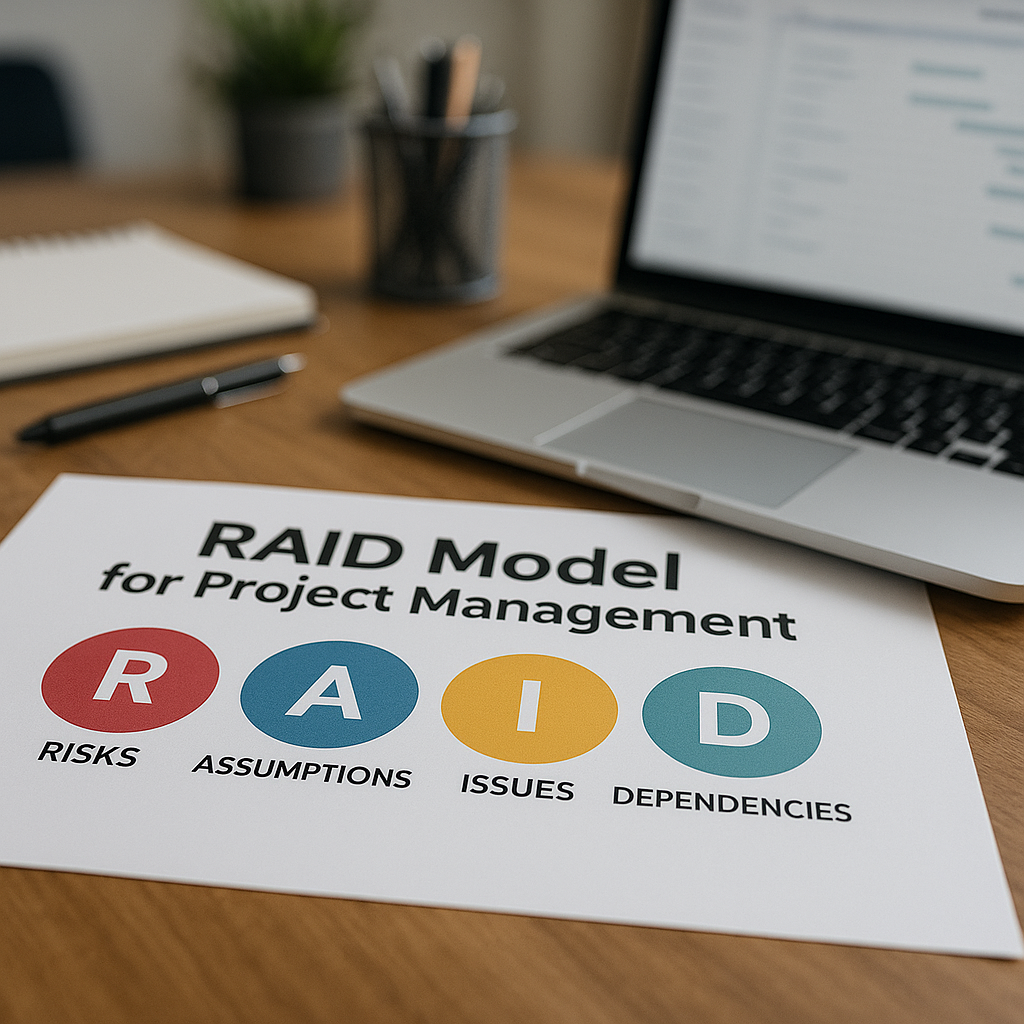
RAID Model Onboarding Guide for Project Leaders
- Core Framework: RAID is a strategic methodology used to manage Risks (future uncertainties), Assumptions (unverified beliefs), Issues (current problems), and Dependencies (task interconnections), significantly increasing project success rates by up to 75%.
- Proactive Management: Effective implementation requires maintaining a centralized RAID Log with assigned owners, priority levels, and clear mitigation or resolution plans to prevent budget overruns and schedule slippage.
- Interconnected Elements: RAID components are dynamic; unvalidated assumptions often turn into risks, while unresolved issues can create new dependencies, necessitating continuous cross-impact analysis.
- Best Practices: Maintain “RAID Hygiene” through regular weekly reviews, transparent stakeholder communication, and the use of visualization tools like Miro or Gantt charts to identify bottlenecks early.
The RAID framework is a fundamental tool for effective project management. It empowers project leaders to navigate complex initiatives with clarity and control. This guide provides a comprehensive overview for new project leaders, ensuring you are equipped for project success from day one.
Definition and Role of RAID in Project Management
The RAID framework is a structured methodology for identifying and managing Risks, Assumptions, Issues, and Dependencies. It supports proactive decision-making and enhances stakeholder communication throughout the project lifecycle. This systematic approach is crucial for achieving project objectives and mitigating potential disruptions.
Studies consistently show that organizations effectively utilizing RAID frameworks are significantly more likely to meet their project goals. In 2021, the Project Management Institute (PMI) found that organizations using strong RAID frameworks were 75% more likely to succeed in their projects than those that didn’t. This underscores the importance of a formal RAID framework in strategic planning and execution.
Components of RAID: Risks, Assumptions, Issues, and Dependencies
Understanding each component of the RAID model is vital for effective project planning and execution. Each element represents a distinct aspect of project reality that requires specific management strategies.
Risks: Future Potential Uncertainties
Risks are uncertain events that can impact project objectives positively or negatively. They are future-oriented. Identifying potential risks early through techniques like SWOT analysis and expert interviews is a cornerstone of proactive risk management. For example, a new technology integration might carry the risk of unforeseen compatibility issues.
Assumptions: Unvalidated Beliefs
Assumptions are unverified beliefs accepted as true for planning. These are often made at the start of a project to facilitate progress. However, unvalidated assumptions can quickly transform into significant risks or issues if proven incorrect. Documenting and regularly validating assumptions is key to preventing project delays and budget overruns.
Issues: Present Realities and Obstacles
Issues are obstacles or problems that have already occurred and require immediate attention and resolution. Unlike risks, which are potential future events, issues are current realities impacting the project. Early issue identification and a clear issue escalation process are critical for minimizing disruption and maintaining project momentum.
Dependencies: Interconnected Task Relationships
Dependencies are relationships between project tasks, where the start or completion of one task relies on another. These can be internal or external. Naturally, managing external dependencies is crucial for reducing schedule slip-ups. Proper dependency mapping clarifies task relationships, helping prevent bottlenecks and ensuring a smooth project flow. Tools like Gantt charts can significantly improve awareness and management of these critical links.
Importance of RAID for Project Success
Adopting a formal RAID framework is not merely a procedural step; it is a strategic imperative for project success. Using formal RAID management leads to higher success rates, with 75% of projects meeting goals compared to 59% without it, according to PMI (2021). This framework significantly enhances risk mitigation and issue resolution effectiveness.
The Project Management Journal emphasizes that thorough RAID analysis improves decision-making, resource allocation, and reduces scope creep and budget overruns. By systematically addressing potential problems and interdependencies, project leaders can steer their initiatives toward successful completion.
Techniques for Identifying and Analyzing Risks
Effective risk identification and analysis are foundational to the RAID model. Techniques include SWOT analysis, expert interviews, brainstorming sessions, and historical data reviews from similar projects. Miro boards can be excellent collaborative tools for these sessions, allowing teams to visualize potential risks.
Beyond identification, qualitative and quantitative risk analysis helps assess the likelihood and impact of each risk. Quantitative risk analysis estimates the potential impact on cost and schedule, helping with proactive planning and effective mitigation strategies. This level of detail is vital for informed proactive decision-making.
Developing and Implementing Risk Mitigation Strategies
Once risks are identified and analyzed, the next step is to develop and implement effective mitigation strategies. Mitigation includes planning and allocating resources to lower the chance of risks or their impact. Studies consistently highlight that continuous risk monitoring significantly reduces project overruns, often by up to 20%.
An effective mitigation plan encompasses detailed actions, designated ownership, and well-defined timelines. This proactive approach addresses potential problems before they escalate, helping ensure project success and alignment with objectives.
Managing Assumptions: Validation and Documentation
Assumptions are critical elements that need meticulous management within the RAID framework. They should be explicitly documented and regularly validated throughout the project lifecycle. This validation often involves data collection, expert review, and sometimes even small-scale pilots or proof-of-concept exercises.
Failing to validate assumptions can have severe consequences. Data points show that unvalidated assumptions are a leading cause of project delays and budget increases. Project leaders can turn potential vulnerabilities into confirmed certainties or recognized risks by actively validating their assumptions.
Early Issue Identification and Resolution
Identifying issues early is crucial for minimizing disruptions and sustaining project momentum. An effective issue tracking system, part of the RAID log process, helps project leaders quickly log, prioritize, and assign issues for resolution. The Project Management Framework emphasizes that swift action on issues prevents them from derailing project timelines and escalating costs.
Implementing well-defined issue escalation processes is essential. Studies show that clear escalation protocols enhance project delivery times by directing critical issues to the right stakeholders, leading to quicker resolution strategies.
Mapping and Visualizing Dependencies
Understanding and visualizing task dependencies is a crucial aspect of project planning and management. Dependency mapping reveals the relationships between tasks, allowing project leaders to identify critical paths and potential bottlenecks before they affect the schedule. Tools like Miro or dedicated project management software are invaluable for creating visual dependency maps.
By clearly illustrating how tasks are linked, project teams can anticipate impacts, optimize resource allocation, and proactively manage potential delays. Focusing on dependency mapping is crucial for avoiding schedule delays and ensuring smooth project execution, which leads to project success.
Definition and Role of RAID in Project Management
RAID stands as a structured methodology for identifying and managing Risks, Assumptions, Issues, and Dependencies. This framework is crucial for proactive decision-making and enhancing stakeholder communication throughout the entire project lifecycle.
The Project Management Institute (PMI, 2021) reports that organizations using RAID frameworks are 75% more likely to achieve their project goals. This statistic underscores its critical role in achieving project success and maintaining strategic planning.
A well-implemented RAID framework empowers project leaders to foresee challenges and develop actionable mitigation strategies. It changes your focus from reacting to crises to a proactive, strategic approach, which is crucial for managing complexity and consistently reaching project goals.
Through robust RAID analysis, you can significantly improve risk management and issue resolution, leading to more predictable project outcomes. This systematic approach is essential for effective project planning, helping to allocate resources better and avoid budget overruns or scope creep.
Components of RAID: Risks, Assumptions, Issues, Dependencies
Each component of the RAID framework addresses a distinct aspect of project management. Understanding their individual definitions and interrelationships is crucial for effective project planning and proactive decision-making. This guide will clarify the core pillars of RAID project management.
Risks: Future Potential and Proactive Management
Risks are uncertain events or conditions that, if they occur, could have a positive or negative impact on project objectives. They are inherently future-oriented and demand proactive risk management. Effective mitigation strategies and continuous monitoring of risks are essential for project success.
For example, a potential delay in vendor delivery is a significant risk. Another common risk is scope creep due to unclear requirements, which can lead to budget overruns. Techniques for identifying and analyzing risks are vital, including SWOT analysis, expert interviews, and historical data reviews. Qualitative and Quantitative Risk Analysis can estimate impacts on cost and schedule, aiding proactive planning and resource allocation.
Assumptions: Unverified Beliefs Requiring Validation
Assumptions are statements believed to be true or expected to happen at the project’s outset, even without definitive proof. They form the basis of project planning. However, they must be validated to prevent future problems from becoming issues. Assumptions Validation is a critical step in the project lifecycle.
An assumption might be that stakeholders will approve documents within 48 hours. Another could be that all team members will be available during deployment week. Unvalidated assumptions can lead to project delays and budget increases, underscoring the need for careful documentation and regular review. The Project Management Institute emphasizes the importance of managing assumptions to mitigate potential issues.
Issues: Present Realities Demanding Immediate Resolution
Issues are current problems or obstacles that are actively impacting the project. They are not potential future events, but present realities requiring immediate attention and resolution. Early issue identification and resolution minimizes disruption and ensures project objectives remain on track. A robust Issue Resolution Strategy is essential.
A server crash is a clear issue that halts progress. Missing design details also represent an active issue preventing the development team from moving forward. Effective use of issue logs enhances resolution speed and supports proactive decision-making. Studies show that issue escalation protocols in a solid Issue Resolution Strategy enhance project delivery times and boost overall project success.
Dependencies: Interconnected Tasks for Seamless Execution
Dependencies are tasks, decisions, or events that the project relies on, or that rely on the project. They define the order in which activities must occur, making Task Dependency Mapping crucial for strategic planning. Understanding these interconnections is vital for effective resource allocation and avoiding project bottlenecks.
For instance, the development team cannot begin coding until the design specifications are finalized; this is a clear dependency. Managing external dependencies naturally reduces schedule slip-ups and prevents budget overruns. Tools such as Gantt charts enhance our understanding of these crucial relationships. Properly mapping dependencies, as noted in the Project Management Journal, can avoid bottlenecks and delays, greatly enhancing project success.
Distinguishing Risks from Issues
The critical difference between a risk and an issue lies in their temporality and certainty. A risk is a potential future event, uncertain in its occurrence, that could impact project objectives. An issue is a current, actual problem that has already happened and is impacting the project.
In successful RAID project management, it’s essential to acknowledge risks such as the possibility of rain tomorrow. This highlights the need for proactive decision-making and mitigation strategies. A pressing concern at hand is the current rainfall, which requires urgent attention and the implementation of an issue escalation process. This distinction drives different management strategies and is fundamental for project success.
| Category | Definition | Key Characteristic | Management Approach |
|---|---|---|---|
| Risk | Uncertain future event impacting project objectives. | Potential, not yet occurred. | Mitigation planning, contingency planning, risk identification and analysis. |
| Issue | Current problem impacting the project’s progress or objectives. | Actual, already occurred. | Immediate resolution, escalation, issue tracking. |
Definition and Role of RAID in Project Management
The RAID framework is a structured methodology for identifying and managing Risks, Assumptions, Issues, and Dependencies (or Decisions). It supports proactive decision-making and stakeholder communication throughout the project lifecycle. According to the Project Management Institute (PMI) in 2021, organizations with strong RAID frameworks are 75% more likely to achieve project goals. This structured approach is central to strategic planning and achieving project success.
Components of RAID: Risks, Assumptions, Issues, Dependencies
Grasping the intricacies of each component is essential for a thorough RAID analysis. Risks are unpredictable events that can impact project objectives, necessitating a thorough assessment and effective mitigation strategies. Assumptions are beliefs regarded as true when a project begins, making it essential to validate them. Issues are obstacles already occurring, necessitating early issue identification and resolution. Dependencies are critical task links affecting schedules and resource allocation, highlighting the importance of dependency mapping.
Importance of RAID for Project Success
Effective RAID management is closely linked to improved project success rates. According to PMI (2021), 75% of projects meet their goals when RAID frameworks are effectively used, versus 59% without. This demonstrates how RAID enhances risk mitigation and issue resolution effectiveness, preventing budget overruns and scope creep. It is a cornerstone for monitoring risks and ensuring project objectives are met.
Techniques for Identifying and Analyzing Risks
Effective risk identification is crucial for mitigating risks. Techniques include SWOT analysis, expert interviews with seasoned professionals like Carl L. Pritchard, and reviews of historical data. Tools like Miro can aid in visualizing these analyses. Qualitative and quantitative risk analysis can estimate impacts on cost and schedule, aiding proactive planning and resource allocation. This systematic approach contributes significantly to project success.
Implementation Workflow: Establishing a RAID Log
Establishing a RAID log at the start of a project is a proactive step towards project success. It provides a centralized register for critical project elements, supporting effective RAID project management.
Using a formal RAID framework makes organizations 75% more likely to achieve project goals, according to the Project Management Institute (PMI, 2021). This underscores the importance of a structured approach from the outset.
Step 1: Project Kickoff Integration and Initial Identification
Start by integrating the creation of a RAID log into your project kickoff activities. This ensures that critical assumptions and potential problems are captured early, before they can derail your timeline or budget. Early issue identification and resolution are vital for project success.
During initial project planning, conduct workshops or brainstorming sessions. Identify potential risks, document initial project assumptions, note any existing issues, and map out key task dependencies. Tools like Miro can facilitate this collaborative process, enhancing risk identification and analysis.
Techniques for Identifying and Analyzing Risks
Effective risk management requires robust identification techniques. Utilize methods such as SWOT analysis, expert interviews, and reviews of historical data. This approach allows for a comprehensive understanding of potential threats to project objectives.
Quantitative risk analysis can estimate the financial and schedule impacts of identified risks, aiding proactive decision-making. Continuous monitoring of risks and developing mitigation strategies are crucial for reducing project overruns by up to 20%.
Step 2: Assign Ownership for Accountability
Assign a specific owner to every risk, assumption, issue, and decision within the RAID log. This prevents items from falling through the cracks and ensures clear accountability. The owner is responsible for monitoring the item and driving its resolution or validation, contributing to effective issue tracking.
This clear ownership promotes proactive decision-making and ensures that the necessary resource allocation is considered for each item. It is a cornerstone of effective RAID log maintenance.
Step 3: Set Priority Levels for Focus
Establish a consistent method for setting priority levels: High, Medium, Low. This helps the project team focus on the most impactful items, ensuring critical issues and risks receive immediate attention. A risk matrix can effectively prioritize risks by severity and likelihood, aligning with qualitative and quantitative risk analysis principles.
Prioritization is essential for strategic planning and managing resource allocation efficiently, especially when dealing with potential budget overruns or scope creep. It guides the project lifecycle effectively.
Step 4: Develop Mitigation and Resolution Plans
For each identified risk, develop a comprehensive mitigation strategy. This reduces its likelihood or impact on project objectives. Mitigation planning should include contingency planning and appropriate resource allocation.
For issues, outline an immediate resolution plan and an issue escalation process. This structured approach to issue resolution strategy minimizes disruption and enhances project delivery times, as studies indicate. This proactive versus reactive RAID management approach is key.
Managing Assumptions: Validation and Documentation
Project assumptions are beliefs held true at the start of a project, but they carry inherent risks. You must explicitly document and regularly validate these assumptions through data collection and expert review. Unvalidated assumptions can lead to project delays and budget increases, impacting project success.
Assumptions validation is a critical aspect of RAID analysis, ensuring that the foundation of your project planning remains sound. It transforms potential future risks into managed certainties.
Mapping and Visualizing Dependencies
Task dependencies are links between project activities that can significantly affect schedules and resource allocation. Dependency mapping clarifies these relationships, helping to prevent project bottlenecks. Tools like Gantt charts can improve awareness and management of these critical links.
Naturally, managing external dependencies reduces schedule slip-ups and contributes to smoother project execution. This is a core component of the RAID framework, ensuring all elements of the Project Management Framework are considered.
Cross-Impact Analysis: How RAID Elements Interact
The elements of RAID do not exist in isolation. They are deeply interconnected, and changes in one category can significantly impact others. This cross-impact analysis is a cornerstone of proactive decision-making in RAID project management.
Assumption to Risk or Issue: Validating Assumptions for Project Success
An unvalidated project assumption can easily transform into a risk. If an assumption proves false, it becomes a potential problem. If it materializes into a current problem, it becomes an issue. This highlights the critical importance of assumptions validation throughout the project lifecycle.
For instance, assuming a key resource will be available (an assumption) becomes a risk if their availability becomes uncertain. If they are then definitely unavailable, it becomes an issue, potentially leading to budget overruns or scope creep. Managing assumptions, validating them, and documenting them explicitly via data collection and expert review is crucial. Unvalidated assumptions can lead to project delays and budget increases, underscoring the need for continuous monitoring and proactive decision-making.
Dependencies and Risks: Mapping for Mitigation
Unmanaged task dependencies can introduce significant risks to a project schedule. A delay in one dependent task can create a ripple effect, impacting subsequent activities and overall project timelines. Dependency mapping is crucial to mitigating these risks and ensuring project success.
Tools like Miro can be invaluable for visualizing these connections, allowing project leaders to identify potential bottlenecks. Naturally, managing external dependencies reduces schedule slip-ups. This proactive approach supports effective risk management and helps achieve project objectives.
Issues Generating Risks: The Iterative Nature of RAID Analysis
A current issue can uncover underlying risks that were not previously identified. Resolving an issue might reveal new uncertainties or potential future problems, necessitating updating the risk log. This iterative process is central to the RAID framework and continuous improvement.
Early issue identification and resolution minimizes disruption; effective use of issue logs enhances resolution speed. Studies indicate that issue escalation protocols improve project delivery times. This continuous RAID analysis and issue tracking are vital for maintaining project health and achieving strategic planning goals.
Interplay of Risks, Issues, and Dependencies in Resource Allocation
Consider a scenario where a high-priority risk materializes into an issue. This issue might then create new dependencies or alter existing ones. Effective resource allocation becomes critical here. If a key technical resource becomes unavailable, it affects related tasks, leading to delays and the need for solutions such as reallocating resources or seeking external help.
Qualitative and quantitative risk analysis helps in understanding these impacts early, allowing for better contingency planning. According to Carl L. Pritchard, a renowned expert in project management, understanding these interconnections is paramount for robust project planning.
The Role of Stakeholder Communication in Cross-Impact Analysis
Effective stakeholder communication is integral to managing cross-impacts within the RAID framework. It’s crucial to inform stakeholders about changes in assumptions, risks, or dependencies to ensure alignment and secure support. This proactive communication facilitates quicker issue resolution and helps in monitoring risks effectively.
The Project Management Institute (PMI) highlights that clear communication with stakeholders is crucial for project success and preventing scope creep. It ensures everyone is aware of potential impacts and contributes to mitigation planning.
Best Practices for 2026: RAID Hygiene
Maintaining an effective RAID log requires consistent effort and adherence to best practices. This ensures its continued relevance and value, directly contributing to project success and proactive decision-making.
Frequency of Reviews and Continuous Monitoring
Schedule weekly RAID reviews to ensure new risks are identified, project assumptions remain valid, and issues receive prompt attention. Integrate these updates into sprint planning and regular project status meetings. Continuous monitoring of risks, assumptions, issues, and dependencies is essential for managing risks, avoiding budget overruns, and preventing scope creep in project management.
Stakeholder Communication and Transparency
Regularly communicate RAID log updates to key stakeholders. This fosters transparency and alignment, which is critical for project success. Tailor the communication to the audience, focusing on impact and required actions. Effective stakeholder communication is vital for managing expectations and securing support for problem-solving and planning, as noted by the Project Management Institute.
RAID in Agile vs. Waterfall Environments
In Agile environments, the RAID log is a living document. It is reviewed and updated frequently, often daily or weekly, during stand-ups and sprint reviews. The focus is on rapid identification and resolution, allowing for dynamic risk management and issue tracking within the project lifecycle. This approach supports proactive decision-making and continuous improvement.
In Waterfall environments, RAID logs might be reviewed less frequently, perhaps monthly or at major project milestones. However, the rigor of documentation and mitigation planning remains high. The Project Management Framework supports both methodologies, focusing on thorough risk assessment and a clear issue escalation process, regardless of the project structure. Carl L. Pritchard’s work often highlights the adaptability of such frameworks.
Checklist for RAID Hygiene: Ensuring Project Success
Adhering to a robust checklist for RAID hygiene is fundamental for maintaining a healthy RAID log and ensuring project success. This involves consistent effort in risk identification and analysis, assumptions validation, and an effective issue resolution strategy.
-
- Regularly review and update all RAID items to ensure their current relevance to project objectives.
- Assign clear owners for each item, fostering accountability for mitigation strategies and issue resolution.
- Prioritize items based on their potential impact and likelihood, guiding resource allocation and focus.
- Develop and track comprehensive mitigation and resolution plans for all identified risks and issues.
- Communicate changes and status to stakeholders proactively, maintaining transparency and alignment.
- Validate assumptions proactively through data collection and expert review, preventing unvalidated assumptions from becoming risks or issues.
- Escalate critical issues promptly using a defined issue escalation process to ensure timely intervention.
- Archive closed items for historical reference, providing valuable insights for future project planning and risk assessment.
Importance of RAID for Project Success: A Data-Driven Approach
Formal RAID management correlates with higher success rates across the project lifecycle. The Project Management Institute (PMI, 2021) reports that 75% of projects achieve their goals when using RAID frameworks, compared to 59% without them. This data underscores that RAID enhances risk mitigation and issue resolution effectiveness, leading to better project outcomes. Adopting formal RAID frameworks is a strategic planning imperative for organizations aiming to achieve their project objectives consistently.
Developing and Implementing Risk Mitigation Strategies
Effective risk management involves more than just risk identification and analysis; it requires robust mitigation planning. Mitigation involves contingency planning and strategic resource allocation to reduce the likelihood or impact of identified risks. Studies show that ongoing risk monitoring, essential for maintaining a RAID log, can cut project overruns by up to 20%. This proactive approach, including qualitative and quantitative risk analysis, is crucial for maintaining project objectives and preventing scope creep.
Managing Assumptions: Validation and Documentation
Assumptions should be explicitly documented and regularly validated throughout the project lifecycle via data collection and expert review. Unvalidated assumptions can lead to significant project delays and budget increases. A dedicated Assumptions Validation process within the RAID framework consistently tests underlying beliefs. This turns project assumptions into confirmed facts or identified risks, enhancing overall project planning.
Early Issue Identification and Resolution: Minimizing Project Disruption
Early issue identification minimizes disruption to project progress. The effective use of issue logs, a key component of RAID project management, significantly enhances resolution speed. Studies indicate that well-defined issue escalation protocols improve project delivery times by ensuring that obstacles are addressed swiftly and efficiently. This proactive approach to issue tracking prevents minor problems from escalating into major project impediments.
Mapping and Visualizing Dependencies: Preventing Bottlenecks
Dependency mapping clarifies task relationships, helping to prevent project bottlenecks and delays. Tools like Gantt charts, often integrated with RAID analysis, improve awareness of how different tasks are interconnected. Naturally, managing external dependencies effectively reduces schedule slip-ups and supports efficient resource allocation. This meticulous approach to Task Dependency Mapping is vital for maintaining project timelines and ensuring smooth project execution.
Practical Examples for Each RAID Category
Here are three hypothetical examples for each category of the RAID framework to help new project leaders improve their identification skills and understanding. These examples stem from a software development project for an e-commerce platform, illustrating the application of RAID project management principles.
Risk Identification and Analysis
In project planning, risk identification is paramount. Risks are potential future events that could negatively impact project objectives. Qualitative and Quantitative Risk Analysis helps in assessing their likelihood and impact, enabling proactive decision-making. Techniques like SWOT Analysis, expert interviews, and historical data reviews are crucial for comprehensive risk assessment. Studies show that continuous risk monitoring can cut project overruns by up to 20%, underlining the need for effective risk management.
-
- Risk 1: A key developer for the payment gateway module unexpectedly leaves the project.
- Impact: This could lead to significant delays in payment processing implementation and potential budget overruns.
- Mitigation: Implement mitigation strategies such as cross-training team members on critical modules and ensuring thorough code documentation. This is a key aspect of mitigation planning.
- Risk 2: A third-party API for shipping integration experiences prolonged downtime during the peak launch period.
- Impact: This would result in an inability to process shipping orders, leading to a negative customer experience and reputational damage.
- Mitigation: Develop robust error handling and fallback mechanisms, and explore alternative shipping APIs as part of your contingency planning.
- Risk 3: Unexpected changes in regulatory compliance for online data privacy (e.g., new GDPR-like regulations) occur.
- Impact: This necessitates rework of data handling processes, introduces legal risks, and could delay the launch.
- Mitigation: Involve legal counsel early in the project and design flexible data privacy features to prevent scope creep.
- Risk 1: A key developer for the payment gateway module unexpectedly leaves the project.
Assumptions Validation
Assumptions are beliefs held true at the project’s outset, but they require continuous validation. Managing Assumptions involves explicit documentation and regular review through data collection and expert review. Unvalidated assumptions can lead to significant project delays and budget increases. This proactive approach is vital for project success and maintaining control over the project management framework.
-
- Assumption 1: The client will provide all necessary product images and descriptions in the required format by the end of next month.
- Validation: Establish a clear content delivery schedule and conduct regular check-ins with the client to track progress.
- Assumption 2: The chosen cloud hosting provider will meet the performance and scalability requirements for projected traffic during major sales events.
- Validation: Conduct thorough load testing, carefully review Service Level Agreements (SLAs), and consult with cloud architects to ensure the provider can handle anticipated demand.
- Assumption 3: The marketing team will have the launch campaign assets (banners, ad copy) ready two weeks before the platform’s go-live date.
- Validation: Establish a clear communication channel, agree on deadlines, and track progress closely to avoid delays in stakeholder communication.
- Assumption 1: The client will provide all necessary product images and descriptions in the required format by the end of next month.
Issue Resolution Strategy
Issues are obstacles that are currently impacting the project. Early issue identification minimizes disruption, and effective issue tracking and resolution strategies enhance project delivery speed. The Project Management Institute (PMI) emphasizes that formal issue escalation protocols significantly improve project success rates. This proactive approach to issue resolution is a cornerstone of effective RAID project management.
-
- Issue 1: The staging server environment has crashed, preventing the QA team from performing critical testing.
- Resolution: Engage the DevOps team immediately to identify the root cause, restore service, and communicate the outage to affected teams. This requires prompt resource allocation.
- Issue 2: A critical bug has been discovered in the shopping cart functionality, preventing users from completing purchases.
- Resolution: Prioritize the bug fix, assign a dedicated developer, deploy a hotfix, and communicate the status to stakeholders to manage expectations and ensure project objectives are met.
- Issue 3: The budget allocated for third-party software licenses has been exceeded by 15% due to an unforeseen increase in user count.
- Resolution: Review current license usage, negotiate with the vendor for better terms, request additional budget approval, and explore alternative solutions to mitigate budget overruns.
- Issue 1: The staging server environment has crashed, preventing the QA team from performing critical testing.
Task Dependency Mapping
Dependencies are crucial links between tasks that affect project schedules and resource allocation. Dependency mapping clarifies task relationships, helping prevent bottlenecks and ensuring smoother project planning. Tools like Miro and Gantt charts improve awareness of these critical connections. Managing external dependencies proactively can significantly reduce schedule slip-ups and contribute to overall project success. This is a vital component of the RAID framework and strategic planning.
-
- Dependency 1: The front-end development of the user dashboard is dependent on the completion and approval of the UI/UX design wireframes.
- Action: Expedite the design review and approval process to unblock the development team.
- Dependency 2: The successful deployment of the e-commerce platform relies on the integration and testing of the chosen payment gateway API.
- Action: Allocate dedicated resources for API integration and schedule rigorous testing to ensure seamless functionality. This requires careful resource allocation.
- Dependency 3: The project’s go-live decision is dependent on receiving final legal approval for the terms and conditions and privacy policy.
- Action: Engage the legal team early in the process, track legal review progress, and clarify any outstanding questions to avoid delays in proactive decision-making.
- Dependency 1: The front-end development of the user dashboard is dependent on the completion and approval of the UI/UX design wireframes.
Importance of RAID for Project Success
Formal RAID management correlates with higher project success rates. According to studies by the Project Management Institute (PMI, 2021), 75% of projects achieve their goals when using RAID frameworks, compared to only 59% without them. This structured methodology for project planning enhances risk mitigation and issue resolution effectiveness, leading directly to improved project outcomes.
Definition and Role of RAID in Project Management
The RAID framework is essential for effective project management, helping to identify and manage potential obstacles and key project elements. It supports proactive decision-making and fosters robust stakeholder communication throughout the project lifecycle. Consistent use of RAID analysis helps project leaders foresee challenges and maintain control, in line with Project Management Journal principles.
Importance of RAID for Project Success
As highlighted by the Project Management Institute, formal RAID management significantly boosts project success. This proactive approach helps project leaders manage risks, confirm project assumptions, quickly resolve issues, and grasp important task dependencies. This strategy, often using tools like Miro for visualization, helps meet project goals efficiently and on budget, avoiding issues like budget overruns and scope creep.
Techniques for Identifying and Analyzing Risks
Effective risk management begins with thorough risk identification and analysis. Techniques include conducting SWOT analysis, engaging in expert interviews with key stakeholders, and reviewing historical project data. Qualitative and quantitative risk analysis estimate the potential impacts on cost and schedule, supporting proactive decision-making and effective mitigation strategies. Carl L. Pritchard’s work often emphasizes the value of early and comprehensive risk assessment.
Developing and Implementing Risk Mitigation Strategies
Once risks are identified, project leaders must develop and implement effective mitigation planning. This involves contingency planning and strategic resource allocation to reduce either the likelihood or the impact of potential risks. Continuous risk monitoring during the project lifecycle is essential, as studies show it can reduce project overruns by up to 20%. Such proactive measures are central to sound project planning and strategic planning.
Managing Assumptions: Validation and Documentation
Project assumptions are beliefs held true at the start of a project, and their proper management is vital. Assumptions should be explicitly documented and regularly validated through data collection and expert review. Unvalidated assumptions can lead to significant project delays and budget increases. Assumptions validation is a continuous process that prevents potential issues from derailing project objectives, ensuring project success.
Early Issue Identification and Resolution
Early issue identification and resolution are critical for minimizing disruption and maintaining project momentum. Effective use of issue tracking and issue logs enhances the speed and efficiency of resolution. Studies indicate that clear issue escalation processes improve project delivery times. A strong Issue Resolution Strategy quickly addresses obstacles to prevent them from becoming major problems that could affect project goals.
Mapping and Visualizing Dependencies
Understanding task dependencies is fundamental to effective project planning and execution. Dependency mapping clarifies the relationships between tasks, helping to prevent bottlenecks and ensure smooth workflow. Tools like Gantt charts improve awareness of these critical links. Naturally, managing external dependencies reduces schedule slip-ups and contributes to overall project success. This proactive approach to task dependency mapping is essential for resource allocation and maintaining project objectives.
Techniques for Identifying and Analyzing Risks
Effective risk identification is the first, crucial step in successful risk management. Project leaders use various techniques for effective Risk Identification and Analysis to understand potential challenges throughout the project lifecycle.
One foundational method is SWOT Analysis. This technique helps you identify internal strengths and weaknesses of your project, alongside external opportunities and threats. A strength could be an experienced team, while a threat might be new market regulations affecting your project goals.
Another invaluable approach involves expert interviews. Consulting experienced individuals, such as senior stakeholders or subject matter experts, can reveal hidden risks from their past project experiences. This leverages collective wisdom to foresee potential issues.
Historical data reviews are also critical. Leveraging past project information, lessons learned, and performance data allows you to identify recurring risks and patterns. This proactive analysis aids in anticipating and preparing for similar challenges in your current initiative, contributing to better project planning.
Both Qualitative and Quantitative Risk Analysis are valuable. Qualitative analysis prioritizes risks based on their likelihood and impact, often using a High/Medium/Low scale. Quantitative analysis estimates the numerical effects of risks on project cost and schedule, helping with better contingency planning and resource allocation. For example, quantitative analysis might project a 15% increase in budget due to a specific technical risk.
Developing and Implementing Risk Mitigation Strategies
Mitigation planning is a proactive effort focused on reducing the likelihood or impact of identified risks. It involves contingency planning and strategic resource allocation. Studies highlight that continuous risk monitoring reduces project overruns by up to 20%, a critical factor for overall project success.
If a key team member leaves, a good way to mitigate this risk is to cross-train other team members. This ensures continuity and prevents potential project delays. Effective resource allocation for these mitigation efforts is also critical, aligning with the principles of proactive decision-making.
The Project Management Institute (PMI) highlights that effective risk management and strong mitigation strategies are linked to greater project success. Organizations that actively engage in mitigating risks are far more likely to meet their project objectives. This proactive approach helps in avoiding budget overruns and managing scope creep effectively throughout the project lifecycle.
When developing mitigation strategies, consider both qualitative and quantitative risk analysis. Qualitative analysis prioritizes risks by assessing their impact and likelihood, while quantitative analysis estimates their financial or scheduling effects. This comprehensive risk assessment informs more precise resource allocation and contingency planning, crucial for maintaining project success.
Managing Assumptions: Validation and Documentation
Assumptions are beliefs held true at the project’s outset, often without concrete proof. These require explicit documentation and regular validation through data collection and expert review. Unvalidated assumptions can significantly increase project delays and lead to budget overruns.
Documenting assumptions creates a clear, auditable record. Regularly reassessing these assumptions with updated information or expert opinions maintains their validity and helps avoid unexpected risks or problems. This proactive approach is a cornerstone of effective project management and contributes directly to project success.
Assumptions Validation is an ongoing process, crucial for maintaining RAID hygiene throughout the project lifecycle. Without proper validation, a simple assumption can turn into a major risk or problem, leading to expensive solutions. Integrating this into your Project Management Framework ensures proactive decision-making.
Assuming a vendor will deliver on time without a formal agreement or checking their past performance is an unverified assumption. If this assumption proves false, it immediately becomes an issue impacting task dependencies and resource allocation. Carl L. Pritchard, a recognized expert, often emphasizes the domino effect of unmanaged assumptions.
The Project Management Institute (PMI) consistently highlights the importance of managing assumptions. Their research, often highlighted in the Project Management Journal, shows that strong Assumptions Validation greatly reduces the chances of scope creep and budget overruns. By actively monitoring these elements, project leaders enhance overall project planning and strategic planning efforts.
Early Issue Identification and Resolution
Early issue detection minimizes project disruption and is a cornerstone of effective RAID project management. Studies indicate that issue escalation protocols significantly improve project delivery times, highlighting the importance of a robust Issue Resolution Strategy. By proactively identifying and addressing obstacles, you can prevent them from derailing project objectives.
Establishing clear channels for reporting issues and defining an effective Issue Escalation Process ensures that problems are addressed swiftly. This proactive approach minimizes their impact on the project timeline and budget overruns. The Project Management Institute (PMI) highlights that organizations using formal RAID frameworks are 75% more likely to achieve project goals, mainly due to improved issue resolution.
Effective use of issue logs enhances resolution speed. These logs serve as a central repository for tracking, assigning ownership, and monitoring the progress of identified issues. This systematic approach supports continuous project success and facilitates proactive decision-making throughout the project lifecycle.
Mapping and Visualizing Dependencies
Dependency maps clarify task relationships, helping prevent bottlenecks. Tools like Gantt charts significantly improve awareness and facilitate effective RAID project management. Naturally, managing external dependencies reduces schedule slip-ups and enhances project success.
Visualizing dependencies allows project leaders to identify critical paths and potential bottlenecks early in the project lifecycle. This allows for early changes to the project schedule and resource use, essential for managing risks and achieving project goals.
Effective Task Dependency Mapping is a visual aid that supports proactive decision-making. Data points show that proper mapping of dependencies can prevent project bottlenecks and delays, directly contributing to project success. Utilizing tools like Miro can further enhance the collaborative visualization of these critical relationships.
Frequently Asked Questions About the RAID Model
As you integrate the RAID framework into your project management toolkit, certain questions naturally arise. Here, we address common inquiries to further solidify your understanding and ensure seamless application of RAID for project success.
What is the primary difference between a risk and an issue in project management?
The fundamental distinction lies in their temporal nature. A risk is a potential future event, uncertain in its occurrence, that could positively or negatively impact project objectives. Conversely, an issue is a current, actual problem or obstacle that is already affecting the project. Effective risk management involves proactive planning to mitigate potential risks, while issue resolution demands immediate action to address present challenges. Carl L. Pritchard, a renowned figure in project management, often emphasizes this distinction for clear strategic planning.
Why is it important to assign an owner to each RAID item?
Assigning an owner to each item within your RAID log is critical for accountability and effective project management. It ensures that a specific individual is responsible for monitoring, validating assumptions, mitigating risks, resolving issues, or tracking dependencies. This proactive decision-making approach prevents items from being overlooked and streamlines the issue escalation process, contributing significantly to project success. Without clear ownership, even well-identified risks or issues can stall, leading to budget overruns or scope creep.
How often should a RAID log be reviewed?
The frequency of RAID log reviews is essential for maintaining RAID hygiene and varies based on the project’s methodology and complexity. In Agile environments, where iterative development is crucial, reviews happen weekly or even daily during sprint planning or stand-ups to identify risks and track issues continuously. For Waterfall projects, a monthly review might suffice, aligning with broader project planning cycles. The Project Management Institute (PMI) stresses the importance of regularly reviewing the RAID log to keep it relevant and support proactive decision-making during the project.
Can a RAID log be integrated with Agile methodologies?
Absolutely. RAID logs are highly adaptable and effective within Agile frameworks. They are often part of sprint planning and daily stand-ups, helping identify risks, validate assumptions, and resolve issues in iterative development. This integration supports proactive decision-making and enhances stakeholder communication, which are vital for Agile project success. Tools like Jira, Asana, and Monday.com often facilitate this seamless integration.
What are some common tools used for creating and maintaining RAID logs?
Various project management tools help create and manage effective RAID logs, aiding in project planning and risk assessment. Popular choices include collaborative platforms like Miro, which offers visual dependency mapping capabilities. Project management software like Jira, Asana, and Monday.com offers features for tracking issues, identifying risks, and allocating resources. For simpler projects or initial RAID analysis, spreadsheets like Microsoft Excel or Google Sheets can also be highly effective. The key is selecting a tool that supports consistent RAID log maintenance and facilitates efficient stakeholder communication.