Kolb Learning Cycle
Introduction
Overview of Kolb’s Experiential Learning Theory
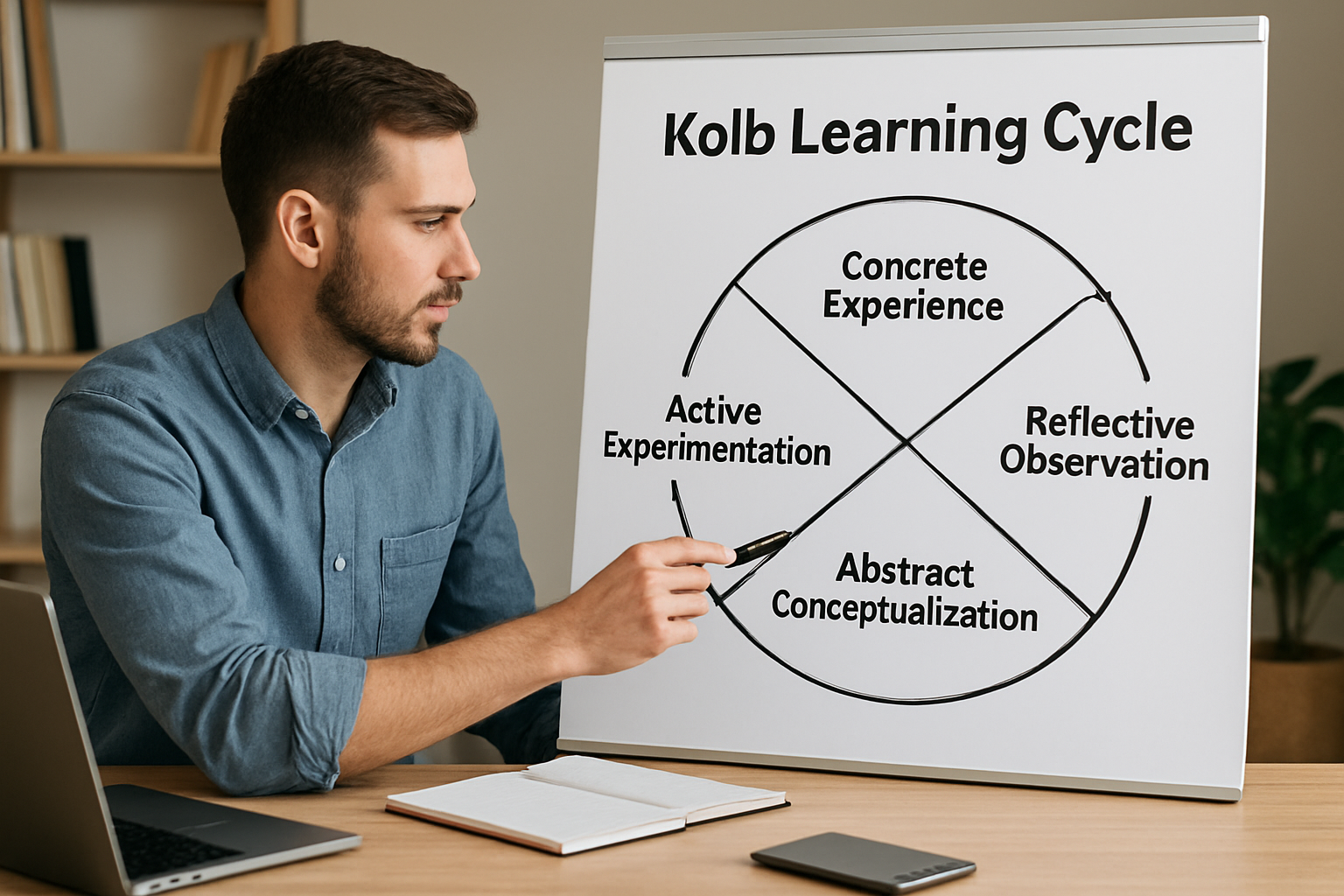
Kolb’s Experiential Learning Theory (ELT) frames learning as a dynamic cycle that blends concrete experience, reflection, conceptualization, and experimentation. It emphasizes transforming experiences into knowledge through a continuous loop, drawing on ideas from Dewey, Piaget, and Lewin to show how perception and action shape learning outcomes.
A core takeaway is that learning thrives when you combine doing with thinking, moving through the four stages in a non linear, iterative way.
Why the Kolb Learning Cycle matters for management, IT, and cybersecurity
For leaders, ELT offers a framework to foster team learning, improve decision making, and strengthen professional development. It supports structured reflection after action and purposeful experimentation in projects.
In IT and cybersecurity, ELT helps translate incidents, trials, and simulations into actionable knowledge. It links concrete events to standards, architectures, and controls to align training with organizational goals.
- Promotes reflective practice after incidents or deployments
- Guides design of immersive training and simulations
- Bridges individual growth with organizational learning goals
1. Concrete Experience (CE) , Engaging Real-World Encounters
Definition and role in the cycle
Concrete Experience is the direct, tangible involvement with a task, event, or activity. It forms the starting point of Kolb’s cycle, supplying raw material for reflection and analysis. This stage prioritizes sensation, immersion, and authentic engagement.
CE anchors learning in reality, ensuring later observations and concepts rest on lived experience.
Designing authentic experiences in business, IT, and security training
- Use real work scenarios drawn from current projects to trigger authentic engagement.
- Incorporate live simulations that mirror day-to-day operations and decision points.
- Align experiences with measurable objectives such as response times, accuracy, or collaboration quality.
Examples of CE in practice
- Leading a cross-functional project sprint to tackle a live customer issue.
- Handling a simulated cybersecurity incident based on actual threat patterns.
- Delivering on-site audits or fieldwork that reflect real governance challenges.
2. Reflective Observation (RO) , Insight Through Reflection
Definition and role in the cycle
Reflective Observation is the stage where learners step back from action to examine what happened. It emphasizes careful watching, monitoring outcomes, and considering multiple perspectives. This phase links concrete experience to the next cycle of thinking and conceptualizing, ensuring insights arise from lived events rather than assumptions.
RO provides the bridge between doing and thinking, inviting learners to identify patterns, biases, and uncertainties. It sets the stage for developing robust interpretations that inform future decisions.
Techniques for effective reflection (journals, debriefs, and discussion)
- Journals: capture impressions, questions, and evolving hypotheses after any experience.
- Debriefs: structured conversations that compare expected vs. actual outcomes and surface learnings.
- Discussion: collaborative reflection to reveal diverse viewpoints and challenge assumptions.
Examples of RO in practice
- Post-incident reviews that document timelines, decisions, and alternative options.
- Team retrospectives that surface root causes and success factors from a sprint.
- Individual coaching sessions that explore personal biases and learning gaps following a project milestone.
3. Abstract Conceptualization (AC) , Turning Experience into Theory
Definition and role in the cycle
Abstract Conceptualization is the stage where learners translate concrete experiences into ideas, models, and hypotheses. It moves learning from what happened to why it happened, enabling generalizable knowledge that guides future actions. This phase emphasizes theory building, frameworks, and principled reasoning.
AC serves as the bridge between observation and action, allowing insights from RO to be structured into concepts that can be tested in AE.
Conceptual frameworks and models to apply (e.g., ISO 27001, IT governance, big data principles)
- Adopt international standards such as ISO 27001 to formalize information security controls and risk management.
- Apply IT governance frameworks to align learning outcomes with organizational strategy and accountability.
- Use data governance principles to guide data-informed decision making, including data lineage, quality, and ethics.
- Integrate risk assessment models to formalize how incidents translate into policy changes and training needs.
- Map lessons to conceptual maps or ontologies that connect events to measurable objectives.
Examples of AC in practice
- Developing an updated incident response playbook grounded in observed failures and recommended controls.
- Creating a teaching manifest that links findings from a security drill to governance requirements.
- Drafting a data governance framework after analyzing data quality issues uncovered in RO.
4. Active Experimentation (AE) , Applying and Testing New Ideas
Definition and role in the cycle
Active Experimentation is the phase where ideas become action. It tests hypotheses derived from AC by implementing changes, methods, or processes to observe their impact in real work. AE feeds new experiences back into CE and RO, supporting a cycle of continuous learning.
Strategies to implement experiments in projects and operations
- Run small, controlled pilots before full-scale rollouts to manage risk.
- Establish rapid feedback loops with short iteration cycles and frequent check-ins.
- Document learning outcomes and adjust objectives based on results.
- Pair experimentation with clear metrics, including time to value and quality indicators.
- Involve cross-functional teams to surface diverse perspectives during testing.
Examples of AE in practice
- Deploying a focused security control in a single system trial to observe its impact on threat reduction.
- Implementing a new incident response playbook in a simulated environment and measuring response speed.
- Testing an automated data classification rule in a pilot data set and evaluating accuracy gains.
5. Interplay Between Stages , How the Cycle Feeds Itself
Non-linear navigation through stages
The learning cycle is not a fixed sequence. Learners move fluidly between CE, RO, AC, and AE as new information emerges. Shifts can occur within a single project phase or across multiple tasks, enabling rapid adaptation and continuous refinement of understanding.
Balancing learning styles in a professional setting
Organizations should design opportunities that span all four stages to accommodate diverse preferences. Rotating roles helps individuals strengthen weaker areas while leveraging strengths, creating a more resilient learning culture.
- Provide experiences that spark reflection for action oriented players and experimentation for concept builders.
- Encourage cross functional pairing to expose different entry points into the cycle.
- Monitor development with mixed method feedback to ensure balanced progression.
Adapting the cycle to team-based work
When teams collaborate, the cycle becomes collective. Shared debriefs surface tacit knowledge, while joint conceptualization translates diverse insights into common standards. This collective looping accelerates knowledge transfer and drives coordinated action.
- Use team retrospectives to align experiences with organizational goals.
- Document emerging concepts as a living framework that guides subsequent experiments.
- Embed the cycle in project governance to normalize learning as an ongoing capability.
6. Kolb’s Learning Styles Connected to Real-World Roles
Concrete-Experience oriented roles
These roles prioritize immersion in events and hands-on tasks. Practitioners learn by doing, observing immediate outcomes, and adapting on the fly. The emphasis is on tangible results and practical demonstrations of capability.
- Field technicians and on-site operators who rely on direct engagement with systems.
- Operations assistants who respond to real-time incidents and adjust actions accordingly.
Reflective-Observation oriented roles
Roles in this category value careful watching, listening, and synthesis. Learners process what happened, compare perspectives, and articulate insights for future use.
- Auditors and compliance analysts who review processes after events.
- Security coordinators who facilitate post-incident debriefs and lessons learned sessions.
Abstract-Conceptualization oriented roles
These positions emphasize models, theories, and structured thinking. Learners translate experience into frameworks, standards, and strategic plans.
- Architects and policy designers who map concepts to governance structures.
- Data scientists and risk managers who formalize observations into principled approaches.
Active-Experimentation oriented roles
Roles in this quadrant focus on testing ideas, prototyping, and driving change. Learners design and evaluate new methods in controlled or iterative ways.
- Project leads who pilot new controls or workflows and measure impact.
- Automation engineers who experiment with scripts and playbooks in test environments.
Mapping styles to leadership, IT, and cybersecurity responsibilities
| Kolb Style | Related responsibilities | Leadership implications |
|---|---|---|
| CE | Operational delivery, hands-on troubleshooting | Promotes rapid decision making in crises and tangible competency. |
| RO | Debriefs, performance reviews, knowledge capture | Fosters psychological safety and learning cultures. |
| AC | Policy formulation, standards, architecture | Drives principled thinking and strategic alignment. |
| AE | Pilots, experiments, rapid prototyping | Encourages innovation and iterative improvement. |
7. Practical Frameworks for Implementing the Cycle
Course design and training programs
Design courses that map authentic experiences to each Kolb stage, followed by reflection, conceptual grounding, and controlled experimentation. Include checkpoints that allow learners to move nonlinearly through the cycle as needed, reinforcing flexibility over rigid sequencing.
Projects, simulations, and case-based learning
Use immersive projects requiring real-world tasks, safe simulations for experimentation, and case studies that demand applying theory to practice. Rotate entry points so participants start at different stages, strengthening adaptability and cross-stage fluency.
Assessment approaches aligned with Kolb
Measure performance across CE, RO, AC, and AE. Combine practical demonstrations, reflective journals, concept maps, and pilot outcomes. Employ rubrics that evaluate both process and results, ensuring feedback closes the learning loop for subsequent cycles.
FAQ
What are the four stages and their order?
The four stages form a continuous cycle: Concrete Experience, Reflective Observation, Abstract Conceptualization, and Active Experimentation. Learners can enter the cycle at any stage and move nonlinearly as needed.
Can learners enter the cycle at any stage?
Yes. Kolb’s model supports entry at any point. You might start with a hands-on task or reflect on a recent activity, depending on prior knowledge and context. The aim is to progress through the cycle to integrate experience, reflection, theory, and action.
How does Kolb apply to corporate training and onboarding?
Design training that ties real tasks to reflection and theory. Use authentic projects to trigger CE, structured debriefs for RO, concise frameworks for AC, and controlled pilots for AE. Align activities with job roles to build transferable skills.
What are common mistakes when applying the cycle?
- Skipping stages or treating one phase as enough for learning
- Overemphasizing theory without practical application
- Imposing a fixed sequence rather than allowing nonlinearity
- Ignoring feedback loops that close the learning gap
Conclusion
Kolb’s Experiential Learning Theory offers a practical lens for turning experience into structured knowledge. By cycling through concrete experience, reflective observation, abstract conceptualization, and active experimentation, teams learn in a continuous, adaptable loop.
In practice, leaders can leverage this cycle to boost team performance, sharpen decision making, and foster professional growth. Emphasize authentic tasks, deliberate reflection, principled reasoning, and safe experimentation to cultivate a learning-enabled culture.
From an organizational learning perspective, the cycle supports explicit knowledge capture, iterative improvement, and feedback-rich processes. Debriefs, cross-functional collaboration, and pilot testing help translate individual learning into shared capabilities.
- Establish clear entry points and feedback rituals to sustain nonlinearity in the cycle.
- Pair CE with RO to surface tacit insights and convert them into repeatable practices.
- Map AC and AE to governance, security controls, and project delivery to close the loop on learning.
Note that literature on learning at scale highlights gaps in translating individual learning into organizational outcomes. To maximize impact, couple Kolb-based activities with systemic knowledge management, cross-team learning, and measurable results.